10 Common Team Process Problems-And Their Solutions

REFLECTION: FOR STUDENTS: “Alone we can do so little; together we can do so much.” – Helen Keller
FOR ACADEMICS: “If I have seen further, it is by standing on the shoulders of giants.” – Isaac Newton
FOR PROFESSIONALS/PRACTITIONERS: “No one can whistle a symphony. It takes a whole orchestra to play it.” – H.E. Luccock
Foundation
Issues with successful Teambuilding and team project execution about in the Quality and Management world, so I will give a quick overview of 10 of the most common team process problems, as well as potential solutions to those problems. Good Team Dynamics has a direct correlation with Team productivity and success, so take problem-solving down to the team dynamics level if you want your teams to thrive.
The ten problems I will discuss-
- Floundering (Failure to Launch or Close)
- Team members using title or authority to influence the team process flow (stealing empowerment)
- Team members who talk too much (making other viewpoints hard to voice)
- Team members who don’t participate enough (leaving potentially valuable input in their heads)
- Blind acceptance of opinions as facts, or team members making opinions sound like facts.
- Rushing to a solution or conclusion before a team has conducted the full problem-solving process
- Damaging Team Dynamics by attempting to explain other members’ motives
- Team members ignoring or ridiculing one another’s values statements made
- Team constantly drifts off the main Agenda and spends too much time on unfocused conversation.
- Conflict involving personal matters
Solving any of these issues begins with three critical items. First, the team must have a clear written Charter to avoid any disagreement about the actual problem, scope, objectives, and timeline currently on the table. Second, the first meeting should establish meeting ground rules for conduct that can be updated as a group as required. Third, it is best to include a member of the team who’s role is Facilitator. The Facilitator’s purpose is not to become involved in the content of the meeting, but to act to help the team avoid slow progress (or roadblocks) during difficult situations and act as a catalyst for the team while evaluating the team objectives and progress. (Russell T. Westcott, 2014)
The Solutions-
The solutions below are not the only solutions or necessarily the best, just examples of overcoming a problem.
- Floundering- The Team Leader or Facilitator should use the Charter to redirect the team to the recorded objectives.
- Team Member(s) Using Organizational Influence to Influence Team Process- Talk to the member or members attempting to use their power to influence the team off-line. Be certain to clarify the impact of their organizational role and how it may affect the team. Highlight the need for consensus, not agreement out of fear team members might feel repercussions for offering dissenting opinions. Ask for cooperation and patience.
- Team Members talk too much- Practice a form of Gatekeeping that structures the meetings in a way that requires the entire team to write down their opinion on a topic of discussion. Then the individual views are discussed as a group one opinion at a time. The “talking stick” technique works well also.
- Team Member reluctant to participate- Once again, a form of Gatekeeping is a good solution when members will not speak up. Lack of input from shyness or intimidation can deprive the team of useful information, so asking each member of the team to speak on the issue will encourage conversation. Direct assignments with the need to report on actions and progress with help foster involvement as well.
- Blind acceptance of opinions as facts- The best solution to this is to respectfully challenge a view being presented as fact by asking for the supporting data.
- Rushing- Remind your Team of the cost (in terms of dollars and lost time) of jumping to the wrong conclusions. Dollars and time carry a lot of weight in decision making.
- Attempting to explain other members’ motives- Avoid pointing fingers; turn to the person who has had their motives explained, and ask, “would you please clarify that for the team” so that motives do not become accusations. If it becomes a consistent issue, take the offender off-line and ask them to stick to the problems and objective evidence. Adding a Conduct rule is possible if there are team dynamics issues (especially when your pool of team members is small).
- Ignoring or ridiculing one another’s values or statements made- Listening and understanding should be emphasized to the team. The Team Lead and Facilitator should support the Discounted person or persons. Remind everyone that some ideas seem crazy until they succeed.
- Digression/tangents- Remind members of the agenda and time estimates. This problem is where a Facilitator is most helpful. Always move the meeting back on track, reminding the Team of the current mission, objectives, and norms established.
- Conflict-Take real conflict off-line and Reinforce ground rules of conduct.
(Russell T. Westcott, 2014)
Conclusion
These problems within a Team should never be solved with generic solutions, and each team will have such a unique perspective that only your team can answer these problems for you. Still, it must be your team together that solves your internal team process problems, or the main issue your team is facing will continue to go unsolved or ineffectively solved.
Processing…
Success! You're on the list.
Whoops! There was an error and we couldn't process your subscription. Please reload the page and try again.


 Try Amazon Prime 30-Day Free Trial
Bibliography
Russell T. Westcott. (2014). The Certified Manager of Quality/Organizational Excellence. Milwaukee, WI: ASQ Quality Press.
How Do You Define Good Leadership?

REFLECTION: FOR STUDENTS:
“The challenge of leadership is to be strong, but not rude; be kind, but not weak; be bold, but not bully; be thoughtful, but not lazy; be humble, but not timid; be proud, but not arrogant; have humor, but without folly.”
— Jim Rohn, entrepreneur and motivational speaker
FOR ACADEMICS:
“A leader is best when people barely know he exists…when his work is done, his aim fulfilled, they will all say: We did it ourselves.”
— Lao-Tzu, an ancient philosopher and founder of Taoism
FOR PROFESSIONALS/PRACTITIONERS:
“A true leader has the confidence to stand alone, the courage to make tough decisions, and the compassion to listen to the needs of others.”
— General Douglas MacArthur
Foundation
I have seen Leadership defined in many ways. One who inspires or influences is a Leader to some. Others see a person who sets an example worthy of following as a Leader. In the Quality world, Leadership is paramount. The Leadership of Quality teams, Major Projects, and Cross-Functional teams are usual functions as a QE or QM. Effective Leadership is a highly complex responsibility. Unfortunately, there is no simple recipe for executing Leadership. Because those you lead will be at varying levels of maturity, this can throw some leaders off. Those leaders who do not consider the maturity factor may not provide the needed guidance. A good leadership model is Hersey and Blanchard’s situational leadership model(Russell T. Westcott, 2014). This model focuses on three factors:
- 1.Task Behavior
- Level of work-related detail & guidance a leader must provide
- Extent to which direct action must be taken with the follower
- Relationship Behavior
- Extent of communication required with the follower
- Amount of coaching/support given a Follower
- Employee Maturity or Readiness
- The ability of follower to assume risk
- Willingness of follower to assume the task
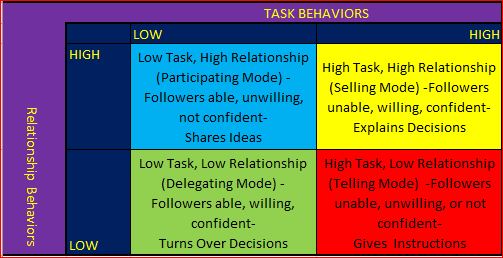
- High Task, Low Relationship (Telling Mode). In this mode of Leadership, specific instructions are given, and close supervision of performance occurs. Using the Telling Mode would be typical for a new employee until the job skill has been developed
- High Task, High Relationship (Selling Mode) This style of Leadership involves an explanation of decisions and an opportunity to clarify and ask questions as the Follower needs. At this stage, the employee has learned the necessary skills but is learning the why of the how.
- High Relationship, Low Task (Participation Mode) The Leader acts as a coach, and ideas are shared and encouragement provided. The Participation stage is the stage just before the training wheels come off.
- Low Relationship, Low Task (Delegating Mode) The leader now shifts responsibility for decisions and implementation to the employee. Successful Delegation is the culmination of a Leader doing their job effectively
(Russell T. Westcott, 2014)
Conclusion
This Model is not a guarantee of success. It is merely a tool to help guide a leader down the right path, enabling a leader to use the most appropriate mode of leadership. One style cannot fit all situations, so a Leader must adapt to the employee and the situation. An outstanding leader will re-evaluate which mode to employe each time a leader interacts one on one. The truly engaged and aware leader needs to be aware of other potential factors, such as health issues, personal/life issues, conflicts caused by co-workers damaging team dynamics, and working conditions. Leading is teaching, but refusing to move beyond the Telling Mode is only “Managing,” not Leading, and will drive good talent away over time.
Processing…
Success! You're on the list.
Whoops! There was an error and we couldn't process your subscription. Please reload the page and try again.
Try Amazon Prime 30-Day Free Trial
Bibliography
Russell T. Westcott. (2014). The Certified Manager of Quality/Organizational Excellence. Milwaukee, WI: ASQ Quality Press.
Basic QA Statistics Series (Part 6) How to Read a Box-and-Whisker Diagram

REFLECTION: FOR STUDENTS:
”Images are the most powerful communicator we have.”
– John Berger, 1926
FOR ACADEMICS:
”We live in a visual intensive society.”
– Paul Martin Lester, 2006
FOR PROFESSIONALS/PRACTITIONERS:
”There is more to visual communications therefore than simply making an image for the eyes to perceive, it has to accommodate the mind of the person being communicated to. That is to say you are not merely making something to be perceived when visually communicating, you are fundamentally making something to be thought about.”
– Aldous Huxley, 1894 –1963
Foundation
The last post promised discussion on the Box-and-Whisker Diagram (or Box Plot). Similar to the Histogram, a box plot is a graphic tool that displays the distribution of the data, but with a critical difference. The box plot shows the Quartiles (minimum, 1st, median, 3rd, and maximum) and clarifying the Interquartile Range- IQR (See the last post) using a box. The “whiskers” of the plot are the minimum and maximum.
Box plots are very useful for quick comparison of multiple sets of data, especially when the focus is on the most critical aspects of the data, or there are not enough data points in each data set to create a reliable histogram. Different Softwares will provide descriptive statistics like the mean value as well.

As you can see, box plots are excellent tools for quickly depicting variation between shifts or machines. Minitab is very effective, but most stat software (even Excel) can easily create a box plot for a presentation with minimal extra effort.
Conclusion
I will be signing off on this short intro to QA statistics, though I will eventually return with a more in-depth series after I have turned my attention back to the broader world of Quality Culture for a while. Thank you all for your enthusiasm for this subject! If you have any subject suggestions, please send them to me!
Processing…
Success! You're on the list.
Whoops! There was an error and we couldn't process your subscription. Please reload the page and try again.
Try Amazon Prime 30-Day Free Trial
 Quality Concepts Matter