How Do You Define Good Leadership?

REFLECTION: FOR STUDENTS:
“The challenge of leadership is to be strong, but not rude; be kind, but not weak; be bold, but not bully; be thoughtful, but not lazy; be humble, but not timid; be proud, but not arrogant; have humor, but without folly.”
— Jim Rohn, entrepreneur and motivational speaker
FOR ACADEMICS:
“A leader is best when people barely know he exists…when his work is done, his aim fulfilled, they will all say: We did it ourselves.”
— Lao-Tzu, an ancient philosopher and founder of Taoism
FOR PROFESSIONALS/PRACTITIONERS:
“A true leader has the confidence to stand alone, the courage to make tough decisions, and the compassion to listen to the needs of others.”
— General Douglas MacArthur
Foundation
I have seen Leadership defined in many ways. One who inspires or influences is a Leader to some. Others see a person who sets an example worthy of following as a Leader. In the Quality world, Leadership is paramount. The Leadership of Quality teams, Major Projects, and Cross-Functional teams are usual functions as a QE or QM. Effective Leadership is a highly complex responsibility. Unfortunately, there is no simple recipe for executing Leadership. Because those you lead will be at varying levels of maturity, this can throw some leaders off. Those leaders who do not consider the maturity factor may not provide the needed guidance. A good leadership model is Hersey and Blanchard’s situational leadership model(Russell T. Westcott, 2014). This model focuses on three factors:
- 1.Task Behavior
- Level of work-related detail & guidance a leader must provide
- Extent to which direct action must be taken with the follower
- Relationship Behavior
- Extent of communication required with the follower
- Amount of coaching/support given a Follower
- Employee Maturity or Readiness
- The ability of follower to assume risk
- Willingness of follower to assume the task
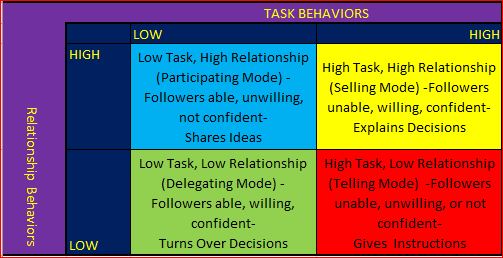
- High Task, Low Relationship (Telling Mode). In this mode of Leadership, specific instructions are given, and close supervision of performance occurs. Using the Telling Mode would be typical for a new employee until the job skill has been developed
- High Task, High Relationship (Selling Mode) This style of Leadership involves an explanation of decisions and an opportunity to clarify and ask questions as the Follower needs. At this stage, the employee has learned the necessary skills but is learning the why of the how.
- High Relationship, Low Task (Participation Mode) The Leader acts as a coach, and ideas are shared and encouragement provided. The Participation stage is the stage just before the training wheels come off.
- Low Relationship, Low Task (Delegating Mode) The leader now shifts responsibility for decisions and implementation to the employee. Successful Delegation is the culmination of a Leader doing their job effectively
(Russell T. Westcott, 2014)
Conclusion
This Model is not a guarantee of success. It is merely a tool to help guide a leader down the right path, enabling a leader to use the most appropriate mode of leadership. One style cannot fit all situations, so a Leader must adapt to the employee and the situation. An outstanding leader will re-evaluate which mode to employe each time a leader interacts one on one. The truly engaged and aware leader needs to be aware of other potential factors, such as health issues, personal/life issues, conflicts caused by co-workers damaging team dynamics, and working conditions. Leading is teaching, but refusing to move beyond the Telling Mode is only “Managing,” not Leading, and will drive good talent away over time.


 Try Amazon Prime 30-Day Free Trial
Bibliography
Russell T. Westcott. (2014). The Certified Manager of Quality/Organizational Excellence. Milwaukee, WI: ASQ Quality Press.
 Quality Concepts Matter
Danny:
I enjoy reading all of your newsletters. This one is no exception.
Education leaders that I know believe it is their function to create followers. As I have written, the job of educational leaders is to create new leaders. Reaction?
LikeLike
I definitely agree that any Educational Leader has a duty to pass on the skill of critical thinking and mentor Leaders of the next generation. Most University Institutions seem to act more like businesses, but they have often failed to capture the fact that not only is the Student the Customer, but the students are also the Product and walking advertisements, so instilling Leadership into your “product” would be the best advertisement for your business (of Higher Ed).
LikeLike