What is an A-3 Report?

REFLECTION: FOR STUDENTS: “Having no problems is the biggest problem of all.”- Taiichi Ohno
FOR ACADEMICS: “Data is of course important in manufacturing, but I place the greatest emphasis on facts.”- Taiichi Ohno
FOR PROFESSIONALS/PRACTITIONERS: “Make your workplace into showcase that can be understood by everyone at a glance.”- Taiichi Ohno
Foundation
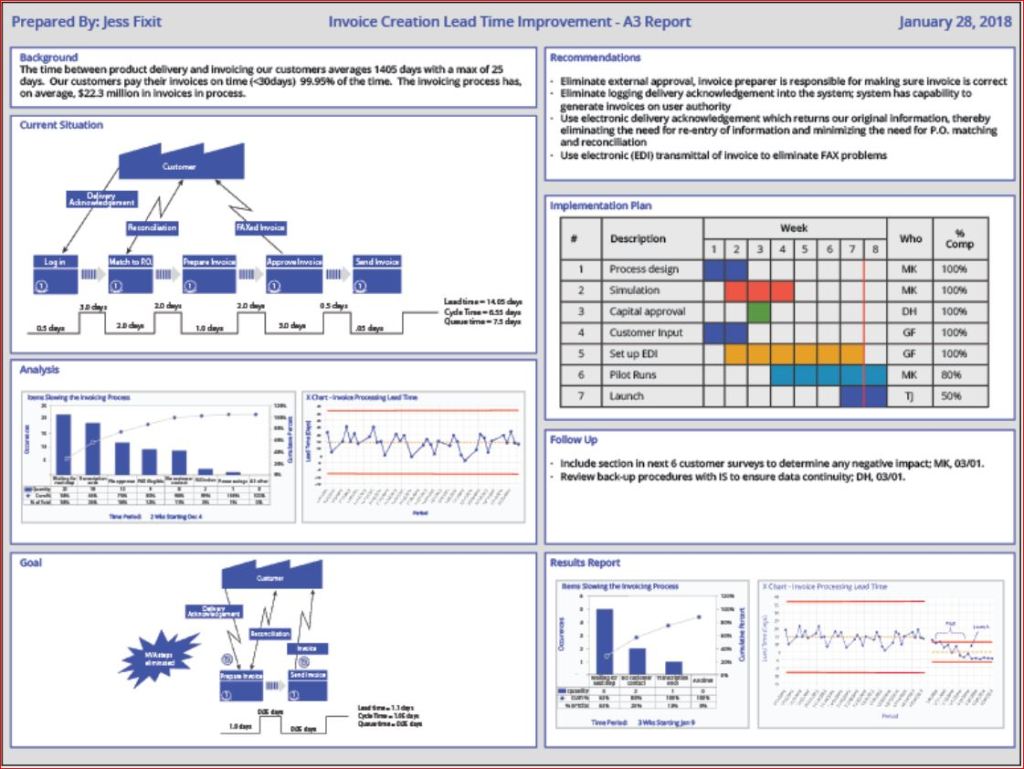
The A3 Report is a model developed and used by Toyota and currently used by many businesses around the world. The A3 Report is named for a paper size-A3 (29.7 x 42.0cm, 11.69 x 16.53 inches). The entire current state and PDCA aspects of the project are captured visually for easy communication and reference. When CIP projects use an A3 methodology to track projects, it has been demonstrated that clear visual communication helps the team members and the overall organization be more aware of the team’s progress.
A minor improvement event, in my experience, is generally four weeks to six weeks. Still, when an issue needs to be addressed thoroughly, the organization must be willing to invest more time and resources. Almost every moment of improvement time spent may be wasted if the true root cause is not adequately addressed due to failure to properly invest resources. There are four distinct phases: 1) preparation and training; 2) process mapping and current state analysis; 3) process mapping and future state analysis; and 4) implementation and ownership. I will put up a basic template below and walk through the A3 report.
Example

- Clarify the Problem
- IS/IS Not Analysis-excellent first tool to use to define the scope of the problem.
- After the scope of the problem has been defined, define the problem relative to the organization or process. The focus should always be on an underlying process or systematic issue, not an individual failure. Systematic failures are frequent but can be corrected with teamwork. The problem statement should never include a suggestion for a solution.
- Breakdown the Problem
- Clearly define the problem in terms of the 5 Why’s and 2 W’s (Who?, What?, When?, Where?, Why? And How?, How much or often?
- Set goals for improvement towards the ideal state vs current state
- Team sets S.M.A.R.T. goals relevant to block 1 state, establishing the end improvement target
- Root Cause Analysis
- Team uses focus areas from block 2 to determine Root Cause(s) employing relevant RCA tools
- Common RCA tools
- Cause-Effect/Fishbone Diagram
- 5 Why Analysis
- Fault Tree Analysis
- Pareto Chart
- Clearly state the determined root cause(s) and display the output of the tools
- Develop Countermeasures
- The team should take the root cause/causes from Block 4 and assign specific countermeasures.
- Countermeasures should directly address the root cause and, in theory, should solve the problem identified in Block 1.
- The completed fifth block is populated with any tool that will outline the countermeasures.
- Implement Countermeasures
- The team tracks the countermeasures from Block 5 and ensures each one is accomplished.
- The completed sixth block should be populated with the tool used in Block 5 to outline the countermeasures and updated as each is accomplished.
- Monitor Results and Process
- Effectiveness Check of Countermeasures
- Before/After Analysis
- SPC Control Charts
- Use Data from block 1 to determine if countermeasures from block 5 are having the desired effect relative to the target.
- If countermeasures are not effective, go back to RCA-block 4 (PDCA) and reconvene.
- Use the tool from block 6 to track countermeasure as ineffective in Block 7
- Effectiveness Check of Countermeasures
- Standardize successful processes
- If countermeasures are effective-
- Standardize all successful processes and note successful countermeasures as Standardized as they are approved using the tool from block 6 in Block 7
- A separate block can be used for Standardized processes
- If countermeasures are effective-
Conclusion
A complete A3 report can use many different tools, depending upon the problem being examined, so don’t fall into the habit of always using the exact same format. Be certain all four phases are completed. Innovation comes from creativity, so leave behind SOPs that demand exact clones of past reports. You may be dealing with a problem no person in your organization has yet to encounter, so outside of the box is thinking should always be on the table (Not locked away in a closed mind)

Processing…
Success! You're on the list.
Whoops! There was an error and we couldn't process your subscription. Please reload the page and try again.


 Try Amazon Prime 30-Day Free Trial
Bibliography
Quality Management Journal, Volume 16, 2009 – Issue 4
Published Online: 21 Nov 2017
Quality Progress Volume 49, 2009 – Issue 1
Jan 2016
Six Common Weaknesses With Teams

REFLECTION: FOR STUDENTS: “If two men on the same job agree all the time, then one is useless. If they disagree all the time, both are useless.” —Darryl F. Zanuck
FOR ACADEMICS: “If you have built castles in the air, your work need not be lost; that is where they should be. Now put the foundations under them.” —Henry David Thoreau
FOR PROFESSIONALS/PRACTITIONERS: “Don’t be afraid to give up the good to go for the great.” —John D. Rockefeller
Foundation
Teams and teamwork are much more a part of Quality and general business culture than a generation ago. The lone wolf “I’ve got this” type is almost extinct- but they are still highly useful due to being productive and often individually creative. I will not make this discussion about individual vs. team performance. The focus of this post will be to highlight some of the common failings in team dynamics (internal and external forces included), to help raise awareness. Too often, a team has become a “magic wand” used to fix a problem, and the team leader may have to drag a lot of that weight if the team does not properly understand how each moving part has to function for full success. When each part of the team has full accountability, the members are much more invested, and the team overall improved.
Team Weaknesses
- Team goals can become misaligned with the goals of the organization
- When teams and/or their decisions are not accepted and supported by management, the efforts of the team are wasted
- Time is needed to build and maintain high-performance teams
- Decision making is typically slower using a team because of the time it takes to make a decision by consensus
- Teams can also create negative synergy, where time is wasted simply because of the effort it takes to work with other people, or because teams get distracted with off-task activities, including social interactions
- Teams can be impacted by “group think”, in which the desire for harmony or conformity in the team results in lack of diversity of thought, shutting down of alternative points of view, and dysfunctional decision making
(WestFall, 2016)
Discussion
The first weakness (more often known as lack of strategic alignment) can make the team feel like they are accomplishing something, only to be informed mid-project or post-project that the overarching organization has a different goal. I would not count that so much as a team weakness, but more as a common communication failure between Management and teams.
Lack of Top Management support is a severe moral dampener to any team. Even if a team is successful despite lack of support, Implementation may not occur when Management offers no support.
Time is money, and because it takes time to build a good team, it drains financial resources. The time required to be dedicated to maintaining teams often pulls focus from day-to-day activities. Tasks required by Teams for special operations should never overwhelm the day to day work of standard operations.
Team Decision Making- Most teams have hit the wall of being unable to reach a consensus. This natural weakness can be overcome by using techniques like multivoting or Nominal Group Technique especially with a facilitator.
Negative Synergy is a common issue and can be well addressed with team self-discipline, a diligent and attentive facilitator, or a combination of both as required.
“Group Think” is one of the worst enemies of effective teams. No member of the team should fear to put forth a dissenting opinion. When a team is open to being questioned, the team is actively practicing critical thinking. One of the ways teams can avoid the phenomenon of “Group Think” is by creating ground rules that require objective data to be presented to make a decision. I would caution, though, that statistics can be twisted to look pleasing to your personal view, so each team member should be just as responsible for confirming the stats on their own after a presentation.
Conclusion
Potential team weaknesses should be considered when evaluating Project Risks. The ability to mitigate those risks as a team will help the team be a more cohesive unit.
Processing…
Success! You're on the list.
Whoops! There was an error and we couldn't process your subscription. Please reload the page and try again.
Try Amazon Prime 30-Day Free Trial
Bibliography
WestFall, L. (2016). The Certified Software Quality Engineer Handbook 2nd Edition. Milwaukee, WI: ASQ Quality Press.
Leadership From the Viewpoint of Motivation

REFLECTION: FOR STUDENTS: “Nothing in the world can take the place of perseverance. Talent will not; nothing is more common than unsuccessful people with talent. Genius will not; unrewarded genius is almost legendary. Education will not; the world is full of educated derelicts. Perseverance and determination alone are omnipotent.”
Calvin Coolidge
FOR ACADEMICS: “Motivation is a fire from within. If someone else tries to light that fire under you, chances are it will burn very briefly.”
Stephen R. Covey
FOR PROFESSIONALS/PRACTITIONERS: “People rarely succeed unless they have fun in what they are doing.”
Dale Carnegie
Foundation
The best leaders understand two key things: The nature of Motivation and the nature and consequences of Self-Betrayal. First, a Leader must realize how one person cannot motivate another. The feeling of motivation is brought about by creating an environment where the person feels comfortable and motivated. There are two categories of motivation: Extrinsic and Intrinsic.
Extrinsic Motivation– The satisfaction gained from material or psychological needs applied by others in the organization through incentive or reward.
Intrinsic Motivation- The qualities of work or of relationships, events, or situations that satisfy basic psychological needs (achievement, power, affiliation, autonomy, responsibility, creativity, and self-actualization) in a self-rewarding process. (Russell T. Westcott, 2014)
The concept of Self-Betrayal is a bit more abstract but inherent in all human beings. An act of Self-Betrayal is an act contrary to what you feel you should do for another person (or even for the organization). (The Arbinger Institute, 2010)
What a Leader Needs to Know about Self-Betrayal
The best way to categorize the behaviors and attitudes that lead to acts of Self-Betrayal is In the Box and Out of the Box. Out of the Box means you see yourself and others more or less as we are- as People or Entities. When you are In the Box, you see yourself and others in a systematically distorted way-Others are mere objects. Existing in the Box can create barriers to effectiveness in change, coping, communicating, implementing new skills, or even changing your behavior.
What Follows Acts of Self Betrayal

- You begin to see the world in a way that justifies the self-betrayal
- Self-Justification (without objective evidence) leads to a distorted view of reality
- You enter The Box
- Over time, individual boxes become characteristics of you, and you carry them with you
- By being in the Box, you provoke others to enter their Box
Getting out of your Box as a leader is essential to leading others out of their Boxes. Being in the Box is not a passive act. Being in the Box is actively resisting what your humanity is calling you to do. While in the Box, you are assigning blame to people rather than trying to help improve. The blame game serves no useful purpose.
Once you stop resisting your natural tendencies and honor your original commitment to do what is best for the person beside you or what is best for the company, most of the barriers will evaporate. (The Arbinger Institute, 2010)
Conclusion
A good leader cannot push “followers”. The very term follower precludes the concept of pushing, so others must be motivated from within, either Intrinsically (just from the internal reward) or driven from within by the feeling that comes with an external incentive or reward (Extrinsically). Culture and the interconnectedness of the organization are essential. Remove yourself from the Box and connect with all others on a human level, or you as a leader will become just an object to your followers, and your followers will begin to seem distorted objects as well. If the entire culture is built upon a distorted reality, nobody will see the organization as a living entity worthy of serving. The organization will morph into an object to be used and abused. Lead your employees and your organization out of the Box, and lead towards a culture that is value-added for all stakeholders.
Processing…
Success! You're on the list.
Whoops! There was an error and we couldn't process your subscription. Please reload the page and try again.
Try Amazon Prime 30-Day Free Trial
Bibliography
Russell T. Westcott. (2014). The Certified Manager of Quality/Organizational Excellence. Milwaukee, WI: ASQ Quality Press.
The Arbinger Institute. (2010). Leadership and Self-Deception. San Francisco: Berrett-Koehler Publishers, Inc.
10 Common Team Process Problems-And Their Solutions

REFLECTION: FOR STUDENTS: “Alone we can do so little; together we can do so much.” – Helen Keller
FOR ACADEMICS: “If I have seen further, it is by standing on the shoulders of giants.” – Isaac Newton
FOR PROFESSIONALS/PRACTITIONERS: “No one can whistle a symphony. It takes a whole orchestra to play it.” – H.E. Luccock
Foundation
Issues with successful Teambuilding and team project execution about in the Quality and Management world, so I will give a quick overview of 10 of the most common team process problems, as well as potential solutions to those problems. Good Team Dynamics has a direct correlation with Team productivity and success, so take problem-solving down to the team dynamics level if you want your teams to thrive.
The ten problems I will discuss-
- Floundering (Failure to Launch or Close)
- Team members using title or authority to influence the team process flow (stealing empowerment)
- Team members who talk too much (making other viewpoints hard to voice)
- Team members who don’t participate enough (leaving potentially valuable input in their heads)
- Blind acceptance of opinions as facts, or team members making opinions sound like facts.
- Rushing to a solution or conclusion before a team has conducted the full problem-solving process
- Damaging Team Dynamics by attempting to explain other members’ motives
- Team members ignoring or ridiculing one another’s values statements made
- Team constantly drifts off the main Agenda and spends too much time on unfocused conversation.
- Conflict involving personal matters
Solving any of these issues begins with three critical items. First, the team must have a clear written Charter to avoid any disagreement about the actual problem, scope, objectives, and timeline currently on the table. Second, the first meeting should establish meeting ground rules for conduct that can be updated as a group as required. Third, it is best to include a member of the team who’s role is Facilitator. The Facilitator’s purpose is not to become involved in the content of the meeting, but to act to help the team avoid slow progress (or roadblocks) during difficult situations and act as a catalyst for the team while evaluating the team objectives and progress. (Russell T. Westcott, 2014)
The Solutions-
The solutions below are not the only solutions or necessarily the best, just examples of overcoming a problem.
- Floundering- The Team Leader or Facilitator should use the Charter to redirect the team to the recorded objectives.
- Team Member(s) Using Organizational Influence to Influence Team Process- Talk to the member or members attempting to use their power to influence the team off-line. Be certain to clarify the impact of their organizational role and how it may affect the team. Highlight the need for consensus, not agreement out of fear team members might feel repercussions for offering dissenting opinions. Ask for cooperation and patience.
- Team Members talk too much- Practice a form of Gatekeeping that structures the meetings in a way that requires the entire team to write down their opinion on a topic of discussion. Then the individual views are discussed as a group one opinion at a time. The “talking stick” technique works well also.
- Team Member reluctant to participate- Once again, a form of Gatekeeping is a good solution when members will not speak up. Lack of input from shyness or intimidation can deprive the team of useful information, so asking each member of the team to speak on the issue will encourage conversation. Direct assignments with the need to report on actions and progress with help foster involvement as well.
- Blind acceptance of opinions as facts- The best solution to this is to respectfully challenge a view being presented as fact by asking for the supporting data.
- Rushing- Remind your Team of the cost (in terms of dollars and lost time) of jumping to the wrong conclusions. Dollars and time carry a lot of weight in decision making.
- Attempting to explain other members’ motives- Avoid pointing fingers; turn to the person who has had their motives explained, and ask, “would you please clarify that for the team” so that motives do not become accusations. If it becomes a consistent issue, take the offender off-line and ask them to stick to the problems and objective evidence. Adding a Conduct rule is possible if there are team dynamics issues (especially when your pool of team members is small).
- Ignoring or ridiculing one another’s values or statements made- Listening and understanding should be emphasized to the team. The Team Lead and Facilitator should support the Discounted person or persons. Remind everyone that some ideas seem crazy until they succeed.
- Digression/tangents- Remind members of the agenda and time estimates. This problem is where a Facilitator is most helpful. Always move the meeting back on track, reminding the Team of the current mission, objectives, and norms established.
- Conflict-Take real conflict off-line and Reinforce ground rules of conduct.
(Russell T. Westcott, 2014)
Conclusion
These problems within a Team should never be solved with generic solutions, and each team will have such a unique perspective that only your team can answer these problems for you. Still, it must be your team together that solves your internal team process problems, or the main issue your team is facing will continue to go unsolved or ineffectively solved.
Processing…
Success! You're on the list.
Whoops! There was an error and we couldn't process your subscription. Please reload the page and try again.
Try Amazon Prime 30-Day Free Trial
Bibliography
Russell T. Westcott. (2014). The Certified Manager of Quality/Organizational Excellence. Milwaukee, WI: ASQ Quality Press.
How Do You Define Good Leadership?

REFLECTION: FOR STUDENTS:
“The challenge of leadership is to be strong, but not rude; be kind, but not weak; be bold, but not bully; be thoughtful, but not lazy; be humble, but not timid; be proud, but not arrogant; have humor, but without folly.”
— Jim Rohn, entrepreneur and motivational speaker
FOR ACADEMICS:
“A leader is best when people barely know he exists…when his work is done, his aim fulfilled, they will all say: We did it ourselves.”
— Lao-Tzu, an ancient philosopher and founder of Taoism
FOR PROFESSIONALS/PRACTITIONERS:
“A true leader has the confidence to stand alone, the courage to make tough decisions, and the compassion to listen to the needs of others.”
— General Douglas MacArthur
Foundation
I have seen Leadership defined in many ways. One who inspires or influences is a Leader to some. Others see a person who sets an example worthy of following as a Leader. In the Quality world, Leadership is paramount. The Leadership of Quality teams, Major Projects, and Cross-Functional teams are usual functions as a QE or QM. Effective Leadership is a highly complex responsibility. Unfortunately, there is no simple recipe for executing Leadership. Because those you lead will be at varying levels of maturity, this can throw some leaders off. Those leaders who do not consider the maturity factor may not provide the needed guidance. A good leadership model is Hersey and Blanchard’s situational leadership model(Russell T. Westcott, 2014). This model focuses on three factors:
- 1.Task Behavior
- Level of work-related detail & guidance a leader must provide
- Extent to which direct action must be taken with the follower
- Relationship Behavior
- Extent of communication required with the follower
- Amount of coaching/support given a Follower
- Employee Maturity or Readiness
- The ability of follower to assume risk
- Willingness of follower to assume the task
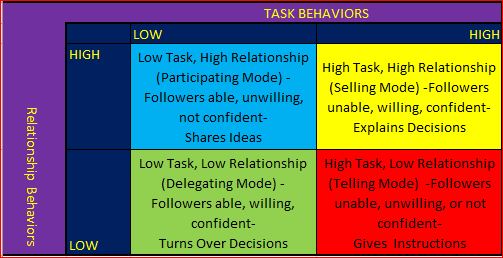
- High Task, Low Relationship (Telling Mode). In this mode of Leadership, specific instructions are given, and close supervision of performance occurs. Using the Telling Mode would be typical for a new employee until the job skill has been developed
- High Task, High Relationship (Selling Mode) This style of Leadership involves an explanation of decisions and an opportunity to clarify and ask questions as the Follower needs. At this stage, the employee has learned the necessary skills but is learning the why of the how.
- High Relationship, Low Task (Participation Mode) The Leader acts as a coach, and ideas are shared and encouragement provided. The Participation stage is the stage just before the training wheels come off.
- Low Relationship, Low Task (Delegating Mode) The leader now shifts responsibility for decisions and implementation to the employee. Successful Delegation is the culmination of a Leader doing their job effectively
(Russell T. Westcott, 2014)
Conclusion
This Model is not a guarantee of success. It is merely a tool to help guide a leader down the right path, enabling a leader to use the most appropriate mode of leadership. One style cannot fit all situations, so a Leader must adapt to the employee and the situation. An outstanding leader will re-evaluate which mode to employe each time a leader interacts one on one. The truly engaged and aware leader needs to be aware of other potential factors, such as health issues, personal/life issues, conflicts caused by co-workers damaging team dynamics, and working conditions. Leading is teaching, but refusing to move beyond the Telling Mode is only “Managing,” not Leading, and will drive good talent away over time.
Processing…
Success! You're on the list.
Whoops! There was an error and we couldn't process your subscription. Please reload the page and try again.
Try Amazon Prime 30-Day Free Trial
Bibliography
Russell T. Westcott. (2014). The Certified Manager of Quality/Organizational Excellence. Milwaukee, WI: ASQ Quality Press.

Visual Management vs The Hidden Factory

The Usual Tools-
- 5S/6S Production Boards (Preferably Electronic for ease of update)
- Schedule Boards/Production leveling
- Tool Boards
- Andon lights/boards
- Kanban System (Pull System)
- Floor Markings/Color Coding
The most common Visual Management methods in factories have been around for quite a while. Providing Management and those being managed with a way to quickly and visibly understand what is happing now and what needs to happen next traces back to military visual standards and Naval flag signals.
Visual communication is the one of the most universal ways of communicating a large amount of information quickly, and the current visual methods could be considered very similar to the ones the original military mindsets used so long ago.
The original Toyota Way has two key pillars- JIT (Just In Time mfg.), and Jidoka (Automation with human intelligence, because work stops immediately when a problem first occurs. This leads to improvements in the processes that build in quality by eliminating the root causes of defects). In War, everything has to be Just in Time, and you don’t keep throwing your troops at the same problem even when you keep losing the battle. You stop and figure out the root cause of your previous loss before you move from a defensive posture.
Visual Controls (if implemented with the correct culture) are excellent management tools.
One of the common cultural issues is the “punishment culture”. When employees are punished/chastised for reporting process failures, quality improvement is not likely to occur, as the factory will become a “Hidden Factory.”
In the Classic “Hidden Factory” Scenario, every department is in its silo and reporting only vertically.
Central Management gets the data funneled to them (but rarely walks the process actively). Few want to admit when something goes wrong, so things they see as inconsequential are omitted. Everyone turns in sterling reports, but the bottom line always suffers. Examples: Rework time, scrap costs, internal investigation costs, customer complaint investigation costs, Re-scheduling costs.
There are a host of visual Controls that can be used in a Lean (or just a practical) workplace to help combat the communications barriers common to factories. The first and most crucial step is a culture change from the top down with full buy-in from the employees before a large-scale implementation can begin. Once the employees are confident they will not be chastised for speaking up about what is wrong internally with the processes, then the implementation can begin (Kubiak, 2017) (CSSBB Primer, 2014).
The Basic Visual Controls to implement are (based upon need):
- 5S/6S
- Sort (Seiri)
- Separate the needed from the unneeded items in the workplace, discarding all unnecessary items
- Set/Straighten (Seiton)
- Arrange in an orderly way- A place for everything and everything in its place (labels and shadow boards are frequently employed at this phase)
- Shine (Seiso)
- Clean and wash the work area
- Standardize (Seiketsu)
- Creation of and regular performance of the first 3 Ss
- Sustain (Shitsuke)
- Discipline to maintain the first four Ss
- The 6th S is emphasized more and more: SAFETY
- Safety should be an emergent property of 5S. Still, sometimes it is not, so safety has been often added to be sure it is addressed, and particular emphasis on safety usually improves job safety overall.
- Sort (Seiri)

5S Will not magically reveal the Hidden Factory (though it will hint at it), but it does help provide the foundation of readiness, safety, discipline, and accountability required. Having the entire workforce learn to maintain their area and be responsible for sustaining the effort is one of the first steps toward a culture of success.
- Production Boards (Preferably Electronic for ease of update)
- Production Boards give an “at a glance” idea of where jobs are, what is coming, what went wrong, and allow everyone to see the outcome without any hidden factory effect (if the culture is correct). Regular and disciplined or automated updates are required, and two-way communication with the floor team during regular meetings at the production board (huddles) is the most effective way to identify possible points of improvement to supervisors so they can assign teams to deal with the issue. It is always best to train floor personnel to solve problems with critical thinking skills rather than trying to direct the entire factory.
- Schedule Boards/Production leveling
- Heijunka Boards can provide clear communication for how the production load is to be smoothed out.
- Unexpected bottlenecks because of unexpected material shortages or constraints due to planning are much less likely if the entire plan is visible to the whole of the factory. Deviations that cause a problem can be addressed, and the need to level the load due to demand is part of the built-in process.
- Tool Boards
- Tool boards will emerge from a 5S program, creating shadow boards to identify any missing tools (an excellent antidote to the disease of not telling anyone that a needed tool is missing). These boards also help shorten cycle times by reducing the time necessary to find tools.
- Andon lights/boards
- Andon Lights usually are green while the workstation is running with no problem. When a sensor detects a problem (or a person manually stops the process), the light shifts to red to signal everyone of machine downtime, a quality problem, tooling issues, operator problems, or material shortages or jams in the process. More sophisticated systems use an electronic board that communicates what the problem is (and where it is) to the entire factory so that the needed people can respond ASAP. Andon lights/boards are an aspect of Jidoka.
- Kanban System (Pull System)
- A visual signaling system (usually using Kanban cards) used to control the flow of inventory in a “pull” system. Kanban controls the flow of WIP and finished goods into and out of “supermarkets,” lines, and production cells. A production Kanban indicates the number of parts needed to replenish what has been consumed (usually rectangular). A withdrawal Kanban shows the number of parts removed from the “supermarket.” A signal Kanban is a type of withdrawal Kanban that triggers production when the minimum amount of containers has been reached (often Triangular). Kanban systems can get much more complicated but are much more effective than traditional inventory management if implemented correctly with the correct cultural mindset in place within the organization.
- Floor Markings/Color Coding
- Markings and color coding are used to indicate flow direction. In a traditional factory tracing the path would look insane. Still, when the machine paths are laid out in the most efficient pathway and marked so that there is no confusion, Cycle times are significantly reduced, and one of the Major Wastes of unnecessarily transporting material is alleviated (Lean Enterprise Institute, 2014) (CSSBB Primer, 2014) (Kubiak, 2017).
Conclusion
When the culture is defensive and non-communicative between departments, only a few at a time know just a portion of what is happening at any one time, and employees are waiting to see what the punishment for the process going wrong is, then the Hidden Factory rules. When communication is openly shared and put on full visual display, and problems are discussed and tackled with minimal regard for rank in a cross-functional way as soon as they arise, good things begin to happen. Those who understand the processes best solve the problems, using visual cues and logic (not commands from supervisors) to run the factory and address problems. The Hidden factory can be significantly reduced by open communication and being willing to face the negatives rather than pretend those negatives do not exist.
REFLECTION: FOR STUDENTS: Is the culture currently conducive to learning to be manager or boss? How do you think the culture you are learning in will help you become more of a coach and less of a boss?
FOR ACADEMICS: Is teamwork being taught purely from a results perspective or from a coaching perspective (to help the students learn critical thinking and problem solving)?
FOR PROFESSIONALS/PRACTITIONERS: Culture eats Strategy for breakfast (a phrase originated by Peter Drucker). No Strategy however brilliant can overcome a culture of fear. Cultural change is the foundation of Quality improvement and must always be attended first, or the attempted QI initiative will be taken down due to resistance to change created by a feeling that a “new culture” is trying to usurp it’s place. For this reason, the culture of change has to cascade from the top down, and buy-in at every level must occur, with cultural buy-in moving to the next level down only after each level is fully (or vast majority) bought in.


Processing…
Success! You're on the list.
Whoops! There was an error and we couldn't process your subscription. Please reload the page and try again.

 Try Amazon Prime 30-Day Free Trial
Bibliography
CSSBB Primer. (2014). West Terre Haute , Indiana: Quality Council of Indiana.
Drucker, P. (1954). The Practice of Management. New York City: Harper & Row.
Kubiak, T. a. (2017). The Certified Six Sigma Black Belt Handbook Third Edition. Milwaukee: ASQ Quality Press.
Lean Enterprise Institute. (2014). Lean Lexicon. Cambridge, MA: Lean Enterprise Institute.

The 7 New Quality Tools

The Seven New Management and Planning Tools
If you have had any formal training in Root Cause Analysis, Problem-solving, or any type of Quality Improvement, then the seven basic QC tools have most likely been taught to you rigorously (See Blog Post https://qualityconcepts.home.blog/category/7-basic-quality-tools/). While the seven tools are sufficient for problem-solving, they are not ideal for management and planning. The need for an expanded toolset was noticed and addressed in 1976 by the JUSE (Union of Japanese Scientists and Engineers) to promote innovation, communicate information, and successfully plan major projects. A JUSE team presented 7 New Quality tools (sometimes called the Seven Management and Planning -MP- tools): Affinity Diagram, Relations Diagram, Tree Diagram, Matrix Diagram, Matrix Data Analysis, Arrow Diagram, and Process Decision Program Chart (PDPC). Often in the modern world, the more complex Matrix Data Analysis is replaced with the similar Prioritization Matrix, so I will cover the Prioritization Matrix rather than the less commonly utilized Matrix Data Analysis tool.
The New Tools were exported to the United States in the mid-1980s and have become standard project management tools in the U.S. and internationally. Not all of these tools were new by any means, but the way they were presented was effective (Tague, 2005).
New Tools:
Affinity Diagram
Relations Diagram
Tree Diagram
Matrix Diagram
Prioritization Matrix
Arrow Diagram
Process Decision Program Chart (PDPC)
Affinity Diagram
Created in in 1960’s by Japanese anthropologist Jiro Kawakita, the Affinity Diagram is a method that organizes a large number of ideas into logical and related groupings.
When to use-
This tool is one of pure abstract analysis, and therefore very useful at multiple points in the process. Whenever your team is overwhelmed with a large number of facts or ideas presented in a chaotic manner, this would be a good time to employ this tool. When the issue(s) seem too large and complex for the team to understand what is usually needed is for the team to see the underlying pattern. Once again, this is an excellent tool. When a team is trying to come to a consensus, this tool helps the team work together to agree upon how the available facts relate to each other.
How to use-
- The most efficient methodology is to utilize a large work surface (wall or whiteboard), sticky notes, and markers.
- Each separate Idea is recorded on a separate note, and all notes are spread out randomly so that everyone can see each note.
- During the next step the team should remain silent, sorting the ideas out into groups (with no category headings). 5-10 is the standard number of groupings but this is dependent upon the complexity of the situation. The team should continue to move the items around (writing multiple notes if it seems they fit into more than one group) until the team has grouped all notes. It is Ok to have “loners” that do not fit any particular group, or for a note to be moved once it has been placed.
- The Team can begin discussion at this point- The shape of the chart, surprising patterns, and why notes were moved between different groups by different people. Some more changes can be made here, and when the groupings are finalized, select a heading for each group.
- Combine groups into Supergroups if the project complexity warrants (Tague, 2005) (ASQ, n.d.).

Relations Diagram
The original term was Relations Diagram, also called: Interrelationship diagram, Interrelationship digraph, network diagram, or matrix relations diagram. This tool is designed to show cause-and-effect relationships while helping a team evaluate the natural relationships between the different nuances of a complex situation.
When to use-
While trying to understand relationships between Cause-and-Effects such as:
- Trying to ID an area of greatest impact for improvement
- During analysis of a complex issue for causes
- During implementation of complex solutions
- As a follow up step to an Affinity Diagram, C&E diagram, or Tree Diagram to more thoroughly explore relationships
How to use-
Gather these basic materials: Sticky notes, large paper surface, markers, and tape.
- Define the issue to explore on a sticky note and place it at the top of the work surface
- Brainstorm ideas about the issue and write them on notes. If another tool was used, then obtain ideas from the affinity diagram, lowest level of the tree, or final branches of the fishbone diagram.
- Place one idea at a time on the work surface and determine if the idea is related to any others. Place new ideas near related ideas leaving room for drawing of arrows later. Repeat until all ideas have been transferred to work surface. Determine how each idea causes/influences other ideas. Draw arrows from each idea to the ones it causes or influences.
- Analyze the diagram
- Count the Arrows in and out for each idea and record at the bottom of each box. The ones with the most arrows are the key ideas.
- Note which ides have mostly outgoing arrows- These are basic causes.
- Note which ideas have mostly incoming arrows- These are final effects that may be critical to deal with.
- Double check that some ideas with fewer arrows may be key as well. (the number of arrows is just an indicator) Draw bold lines around key ideas (Tague, 2005) (ASQ, n.d.).
Tree Diagram
The Tree Diagram progresses from one event/goal and cascades downward in a spreading system of branches made of possible causes/paths. The tree diagram is useful in many different aspects, including CTQ translation, Decision making process mapping (Decision Tree), Fault tree analysis (root cause analysis), Work Breakdown Structure, and Countermeasure tree.
When to use-
- When a known issue is known at a general level and more specific details are needed
- When determining steps required to achieve a goal or actions required to reach a solution
- Detailed process analysis
- Root Cause Analysis
- Evaluating best solution among many potential
- When a clear communications tool is needed
How to use-
- Develop statement for goal, project, plan, problem, or issue that is being studied.
- Ask a question to help determine the next level of detail, such as
- How can this process be completed in the most efficient way?
- Why did this occur?
- What are the pieces of the whole?
- Brainstorm all possible answers (works best with cross-functional team). If other tools have provided information, utilize them.
- Tree can be horizontal or vertical. Write each tier of idea in a line and connect it with the idea above it. Show links between tiers with lines/arrows. Confirm all items in a tier are needed for the tier above it, determine that all items in the tier would be sufficient.
- Every new Tier becomes the next “goal tier” and continue until the tier has reached the fundamental elements, and the contents of the diagram can be logically confirmed as needed and sufficient from objective to fundamental elements (Tague, 2005) (ASQ, n.d.).

Matrix Diagram
The Matrix Diagram helps to demonstrate relationships between multiple groups of information. It can provide information about the relationship, including Strength, role played, measurements, etc. There are six different Matrices possible: L-, T-, Y-, X-, C-, and roof-shaped, depending on how many groups there are. This tool is very generic and may be adapted broadly.
When to use-
- When attempting understand how groups or groups of items interrelate to one another
- When conveying how groups or groups of items interrelate for the sake of clear communication
- An L-Matrix relates two groups of items to each other (or one group to itself)
- A T-Matrix relates three groups- A relates to B, A relates to C, but B does not relate to C
- A Y-Matrix relates three groups with each group related to the other two circularly: A to B, B to C, C to A
- A C-Matrix relates three groups simultaneously
- An X-Matrix relates four groups of items, with each group related to two others circularly A to B to C to D to A, but not A to C or B to D
- A roof-shaped Matrix relates one group to itself, usually used with an L- or T-Matrix
How to use-
- Isolate groups to be compared
- Choose the appropriate matrix format
- Create Grid
- use row labels and column headings for item groups
- Determine what information needs to be displayed with the symbols on the matrix. Create a legend (strong/weak/moderate for example)
- Compare groups item by item, marking appropriate symbol at the matrix intersection of paired items
- Analyze Matrix for patterns and repeat as desired with a different format to learn more (Tague, 2005) (ASQ, n.d.).
This is a complex tool so for further explanation I would direct you to the ASQ Resources link that will more thoroughly answer any questions you have.

Prioritization Matrix
The Prioritization Matrix is a L-Shaped matrix that compares a list of options/needs to a set of criteria, in order to help choose the best options when too many options are available, or to set the options in order of priority. This is an extremely rigorous method and can be quite time consuming when performed properly as a cross-functional group.
How to Use-
- Determine your criteria and rating scale.
- Establish criteria weight.
- Create the matrix.
- Work as a team to score options based upon weighted criteria.
- Discuss results and prioritize your list (Tague, 2005) (ASQ, n.d.).

Arrow Diagram
The Arrow Diagram is a very powerful project planning tool. The Arrow Diagram has evolved over time and as project management has become more prominent. Some of the terms used to describe an arrow diagram are: Activity Network Diagram, Network Diagram, Activity Chart, node diagram, CPM -Critical Path Method- Chart, and PERT -Program Evaluation and Review Technique- chart.
I will only be addressing the higher-level aspects of the arrow diagram. The base materials needed are Sticky notes, markers and a large paper writing surface (such as brown paper).
When to use-
- When organizing and scheduling tasks for a complex project/process with a specific goal
- When you already know the individual steps of the project, their required sequence, and the length of time each step will take to complete
- When the project schedule is critical, and missing the deadline could be a major negative, or completing the project early due to good time management would provide positive returns.
How to use-
- Write out all tasks in the project or process on a sticky note, placing and arrow under the project task pointing to the right.
- Sequence the tasks.
- Which tasks must happen before the previous one can begin?
- Which tasks can be done at the same time?
- Which tasks should happen immediately after each task?
- Diagram the network of tasks. Arrange them in sequence on a large piece of paper. Time should flow from left to right and concurrent tasks should be vertically aligned. Leave space between the notes.
- Between each two tasks, draw circles for “events.” An event marks the beginning or end of a task and can help visually separate tasks.
- When the network is correct, label all events in sequence with event numbers in the circles.
- Determine task times—the best estimate of the time that each task should require. Use one measuring unit (hours, days, or weeks) throughout, for consistency. Write the time on each task’s arrow.
Determine the critical path (the longest path) from the beginning to the end of the project by summing all of the potential paths from beginning to end of project. Mark the critical path with a heavy line or color. (Tague, 2005) (ASQ, n.d.)

Process Decision Program Chart (PDPC)
This tool is a version of the tree diagram that is designed to identify all that might go wrong in a plan being developed. Utilizing PDPC allows the team to create Countermeasures for those possible failures, or the plan can be outright revised to eliminate those failure possibilities.
When to use-
- Before full implementation of a plan
- When the plan is complex
- When completion of the plan on schedule is critical
- When failure has high repercussions
How to use-
- Develop a high-level tree diagram of the plan or process using at least three levels and one main objective at the top of the tree
- Brainstorm all that could go wrong at current lowest level
- Review the problems, and as a team eliminate the highly unlikely items or those with minimal impact to the plan/process. Create a new lower level from these remaining problems linked to the tasks
- For each problem brainstorm countermeasures and prepare contingencies for the plan/process problems. Countermeasures are recorded on the next level.
- Decide upon practicality of countermeasures using criteria like cost, time, ease of implementations, and effectiveness. Mark the impractical countermeasures with an X and the practical with an O (Tague, 2005) (ASQ, n.d.).

Conclusion
Granted, these tools do not always have to be used in order to plan and manage a successful project. The primary reason these tools were conceived was to foster better team communication and team analysis. I would consider the team leader who fails to use methods that have been proven over time to improve outcomes a leader who does not lead with innovation, or even best practices, and who could be putting projects at risk.
REFLECTION: FOR STUDENTS: Are you challenging your team members to properly address the assignment given to your team by using management tools, rather than the dreaded “lay it all on those who will do the work” behavior, and cognizant of how that will impact your behavior as a future manager?
FOR ACADEMICS: Is the teamwork methodology commonly used in higher learning representative of real world Project Management?
FOR PROFESSIONALS/PRACTITIONERS: These tools can initially be cumbersome to implement, but they are good instruments to help break the silo mentality. Communication is the key to cross-functional success.


Processing…
Success! You're on the list.
Whoops! There was an error and we couldn't process your subscription. Please reload the page and try again.
Try Amazon Prime 30-Day Free Trial
Bibliography
ASQ. (n.d.). THE SEVEN NEW MANAGEMENT AND PLANNING TOOLS. Retrieved from ASQ Resources: https://asq.org/quality-resources/new-management-planning-tools
CSSBB Primer. (2014). West Terre Haute , Indiana: Quality Council of Indiana.
Kubiak, T. a. (2017). The Certified Six Sigma Black Belt Handbook Third Edition. Milwaukee: ASQ Quality
Tague, N. R. (2005). The Quaity Tool Box. Milwaukee: Quality Press.
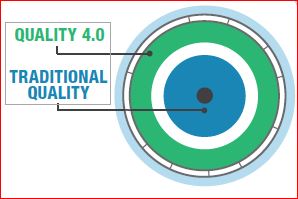
The Technology for Industry 4.0 is Here, but Quality 4.0 is at 3.0 Going on 4.0 (With Still More Growing To Do)!

REFLECTION: FOR STUDENTS: Are the current Management frameworks you have been taught sufficient for Industry/Quality 4.0, or will you have to shift your perspective to be viable?
FOR ACADEMICS: Are you teaching two years behind (as is common with textbooks) or are you also including the coming impact of Quality 4.0 and disseminating that required knowledge to your students?
FOR PROFESSIONALS/PRACTITIONERS: Always focus maintaining and improving on the current state, but plan for the achievement of the future state or the future state will never be realized.
Industry 4.0
For many years, the quality culture has been the lighthouse that lit the way down the path, guiding industry toward the reduction of waste and higher levels of customer satisfaction and retention, but things have been evolving. Industry has gone through many changes, and those changes always have required Quality to adjust.
Industry revolution 1: machine manufacturing, steam power, and the migration to city living for people who had previously been agriculturalists. (Quality moved from guilds into the role of inspection)
Industry revolution 2: The production line and mass manufacturing drastically reduced the cost of consumer and industrial products. (Quality developed more efficient quality management tools)
Industry Revolution 3: Barely a revolution, but significant. Electronics and control systems have gradually penetrated manufacturing, allowing greater flexibility and more sophisticated products at a significantly lower cost until ERP and PLM have become the standard. (Quality began to utilize data to analyze costs/customer complaints and reduce enterprise costs due to quality failures)
Each industrial revolution brought about new patterns of quality management. As Deming emphasizes, if the industrial culture is not Quality-oriented, it will ultimately displease the customer. Still, right now, the fourth industrial revolution is upon us, and Quality, though fully aware of the future state goals, is still working on perfecting the foundations of Quality 3.0. At the same time, Industry 4.0 is off and running.
Industry 4.0 consists of Many critical technology changes and advancements that have enabled technology to become more predictive and communicative, including advances in data, analytics, connectivity, scalability, and collaboration. The digital impact of the third revolution is magnified dramatically. It evolves industry into a phase where AI helps solve problems proactively rather than picking through the past failures to figure out what went wrong. This phase will touch every aspect of industry, connecting people, machines, and data in new ways, and provides access to technologies that were previously only accessible to a skilled few and heralds transformative capabilities such as those in material science and 3D Printing.

Adapted from Quality 4.0 Impact and Strategy Handook
What is Quality 4.0?
These are the primary axes of Quality 4.0 I want to discuss:
- Data
- Analytics
- Connectivity
- Collaboration
- Scalability
- Management Systems
- Compliance
- Culture
The effect of the implementation of these technologies is essential to quality because they allow for the transformation of culture, leadership, collaboration, and compliance. Quality 4.0 is genuinely not about technology, but the users of that technology, and the processes they use to maximize value. Quality 4.0 doubtlessly includes the digitization of quality management. It is more important to consider the impact of that digitization on quality technology, processes, and people. Quality 4.0 should not be sold as a buzzword system to replace traditional quality methods, but rather as a framework designed to improve upon the practices already in place. Manufacturers should use the 4.0 framework to interpret their current state and identify what changes are needed to move to the future state (just like any traditional CIP project), but do not let the daunting task of implementation scare top management away.
Data:
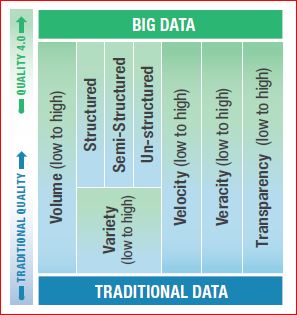
Deming said it best: “In God we trust, all others must bring data.” Data has been driving quality decisions, change, and improvement for a very long time and Evidence-based decision making has become less an anomaly and more the standard. Still, industry has a long way to go toward fully integrating the quality culture. As can be seen in the chart, a portion of the more mature companies have mastered traditional data and have begun leveraging big data. However, the struggle is still genuine and not yet a true cohesive culture across all areas internally or across industries.

Data has five critical elements that must be captured from a practical and cultural perspective-
VOLUME: Traditional systems have a large number of transactional records (e.g., corrective and preventive action (CAPA), NCRs, Change Orders, etc.). The volume of data from connected devices is many orders of magnitude more significant and will continue to grow, requiring specialized approaches such as data lakes, and cloud computing
VARIETY: Systems gathers three types of data: structured, unstructured, and semi-structured. Structured data is highly organized (CAPAs, quality events). Unstructured data is un-organized (e.g., semantics data, data from sensors, and connected devices). Semi-structured data is unstructured and has had structure applied to it (e.g., metadata tags).
VELOCITY: This is the rate at which a company gathers data.
VERACITY: This refers to data accuracy. Quality system data is often low fidelity due to fragmented systems and lack of automation.
TRANSPARENCY: The ease of accessing and working with data no matter where it resides or what application created it.
Analytics:
Analytics are the tools that reveal what the terabytes of data can tell us. Unfortunately, quality often stumbles over analytics. 37% of the market identifies weak metrics as a top roadblock to accomplishing quality objectives. Because there is insufficient adoption of real-time metrics by most of the market, we are often acting on the past, not the current situation.
Analytics fall into four categories- Descriptive (number of open quality events), diagnostic metrics (quality process cycle times to identify bottlenecks), Predictive metrics such as trend analysis (application of trend rules to SPC data), and Predictive using Big Data analytics, or Machine Learning (ML)/AI to traditional data or Big Data (predicting failures of a specific machine or process).
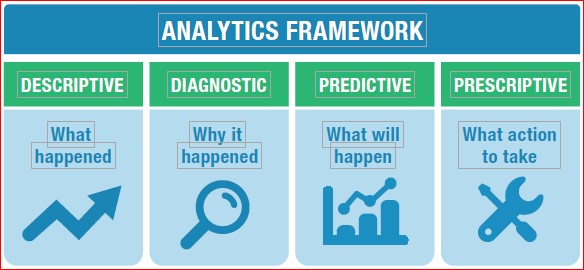
Companies attempting to achieve Quality 4.0 should construct their analytics strategy after or concurrently with their data strategy. Powerful analytics applied to low veracity data will only provide low veracity insights.
Connectivity:
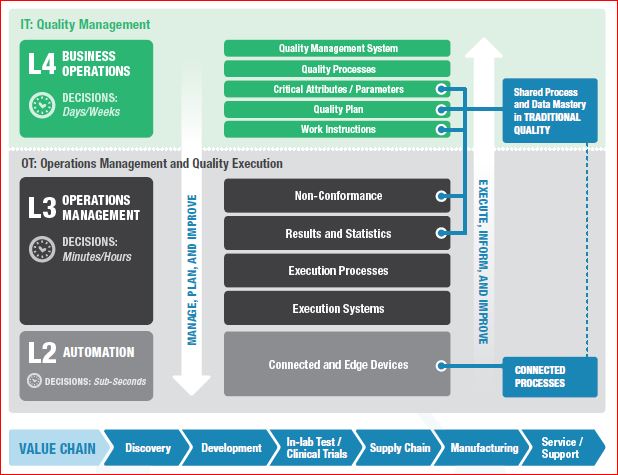
“Connectivity” in the modern industrial age is the cascading multi-direction connection between business information technology (IT) and operational technology (OT), enterprise quality management system (EQMS), enterprise resource planning (ERP), and product lifecycle management (PLM), with OT at the level of technology used in laboratory, manufacturing, and service. Industry 4.0 transforms connectivity through a proliferation of inexpensive connected sensors that provide near real-time feedback from connected people, products and edge devices, and processes.
- Connected people can leverage personal smart devices or intelligent wearable devices that sense workers or their environment. The Connected worker programs usually have goals of increased efficiency and safety.
- Connected products can provide feedback on their performance across their lifecycle.
- Connected edge devices efficiently connect sensed equipment. Edge devices often perform analytics at the device, helping to make predictive/prescriptive decisions (shut this machine down and come for repair), and decide which data to send to central OT systems.
- Connected processes provide feedback from connected people, products, and equipment into processes. This broad element of connectedness allows for the overall reduction of the decision process by providing accessible data and reliable analytics
Collaboration:
Quality management requires collaboration. Quality is inherently cross-functional and global. With the help of digital messaging (email, IM), automated workflows, and online portals, companies execute traditional quality business processes. Much of the market has yet to take advantage of automated workflows and portals, while only 21% have adopted a core EQMS.
Collaboration is a powerful fuel for innovation and quality improvement and has been profoundly transformed and magnified by connectivity, data, and analytics. Leaders should consider how they collaborate and build a secure and reproducible data sharing strategy that meets objectives such as better competency, more streamlined oversight, improved security, and auditability. The approach of collaboration is often part of the culture, and reproducing it can be difficult.
Scalability:
Scalability is the ability to support data volume, users, devices, and analytics on a global scale. Without a global scale, traditional quality and Quality 4.0 are not nearly as effective, and a company is unable to harmonize processes, best practices, competencies, and lessons learned corporate-wide. Thirty-seven percent of companies struggle with fragmented data sources and systems as a top challenge in achieving quality objectives. Scalability is critical to Quality 4.0
Management Systems:
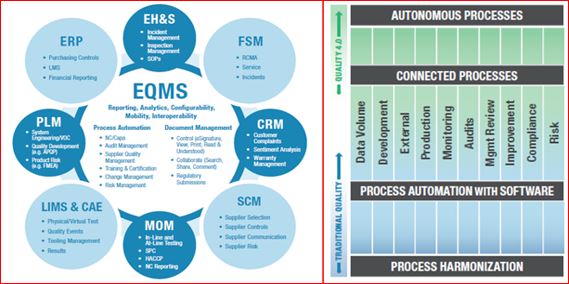
The EQMS is the Center of all quality management connectivity and provides a scalable solution to automate workflows, connect quality processes, improve data veracity, provide centralized analytics, ensure compliance, and foster collaboration within a universal app. It is a hub because quality touches every part of the value chain and how it’s managed. Over the last 50 years, business has slowly realized that quality was not the bad guy but was, in fact, the helping hand to allowing us to have the capacity to remove much of the hidden factory.
There has been some progress on EQMS adoption, but many companies are still critically lagging. Even those that adopt EQMS have not utilized it in an integrated fashion. Only 21% of the market has adopted EQMS, and of those, 41% have adopted a standalone unintegrated approach, leading to fragmentation. Fragmented core processes and resistance-to-change create the current situation. While CAPA/non-conformance is globally harmonized at 25%, 36% of manufacturers have not harmonized any processes, and the median harmonization rate of a single process is an abysmal 8%
Compliance:
Compliance would include conforming to regulatory, industry, customer, and internal requirements. Life science manufacturers/ have a particularly heavy compliance burden, but many other sectors are even more burdened by compliance with regulations. Compliance is essential to quality teams across all industries since quality often takes a lead role in ensuring that processes, products, and services not only conform with requirements but are safe for the public. Manufacturers already leverage technology in every way possible to help reduce the cost and effort to comply (work smarter, not harder). Initial attempts at implementation of compliance technology required considerable custom code to address requirements. While helping to achieve compliance, custom code was difficult to upgrade and revalidate. This result was often known as “version lock,” where companies chose to delay upgrades by many years to avoid the cost and effort of migrating and revalidating code and data.

Quality 4.0 provides further opportunities to automate compliance. Active real-time collaboration offers a mechanism to share successful and failed approaches to compliance across groups, sites, and regions. Analytics can be used to implement internal alerts and preventative measures for organizations to automatically address potential compliance breaches or act to prevent the violations. Integrated IT/OT data models and/or collaboration technologies like blockchain can provide a data-driven approach that automates auditability.
Culture:
Leaders should feel the drive to develop a Culture of Quality since Quality often owns the ultimate responsibility for process execution with insufficient cross-functional participation and ownership from other functions. A company that has “a Culture of Quality” exhibits four key elements: process participation, responsibility, credibility, and empowerment. Companies need to set goals for cross-functional process participation, cross-functional responsibility for Quality, credibility for Quality and its work across functions, as well as cross-functional empowerment. In traditional settings, achieving all of this concurrently can be quite tricky, in part due to regulatory burden, weak metrics and metric visibility, fragmented data systems and sources, (not to mention fragmented processes). Quality often presents itself to employees as a giant maze of regulation and rules; more like the “quality police” than CIP. Only 13% of cross-functional teams clearly understand how Quality contributes to strategic success. Quality 4.0 can make a culture of Quality much more attainable through better connectivity, visibility, insights, and collaboration. Connected data, processes, analytics, apps, etc., will help to improve the Culture of Quality through shared/connected information, insights, and collaboration. Quality 4.0 makes quality processes and outcomes more visible, connected, and relevant. Community is the primary component of Culture.

Conclusion
Manufacturers looking to improve quality should assess where they stand on each of the key Axes of Quality 4.0 and prioritize investments for the long term. Given the current state of Quality in the market, it is probable that many companies will find themselves required to make investments first in traditional quality before they can fully become part of Quality 4.0. If the foundation (Quality 3.0) is not yet fully developed, any company would be foolish to build on shifting soil.
There are clear interrelationships among the axes, and any company that is willing to add new capabilities to individual axes enables new applications on others. Quality 4.0 makes critical new technologies affordable and accessible, and the story of Quality 4.0 is really about the application of these technologies to solve long-standing quality challenges and to reoptimize to provide novel solutions. Quality 4.0 is real, gaining momentum, and inevitable. Quality leaders should prioritize Quality 4.0 plans. Those that stay on the sidelines are at a high risk of being left behind- but follow the right game plan and don’t fall for buzzword packaging that promises “a new kind of quality.” You will have to invest but invest in yourself, and with those who genuinely know Quality. If you do not, those executives eager for a quick financial return will ok the “solve all your problems” fix solicitors try to sell you. When it fails, the natural resistance to organizational change will kick in double and it will be even harder to convince anybody that the change is worth re-initiating. “Do It Right The First Time” (-John Wooden)
The paper I got the most comprehensive information from was QUALITY 4.0 IMPACT AND STRATEGY HANDBOOK (from LNS Research), which detailed 11 axes of quality. Still, I only addressed the 8 I felt were pertinent to most quality professionals, but the link to the white paper can be found in the bibliography. I would recommend the Handbook if you need a more detailed evaluation of Quality 4.0 and future requirements (Dan Jacob, 2017).
Processing…
Success! You're on the list.
Whoops! There was an error and we couldn't process your subscription. Please reload the page and try again.
Try Amazon Prime 30-Day Free Trial


Bibliography
ASQ. (n.d.). The History of Quality. Retrieved from https://asq.org/quality-resources/history-of-quality
Dan Jacob. (2017). Quality 4.0 Impact and Strategy Handook. Retrieved from https://www.sas.com/content/dam/SAS/en_us/doc/whitepaper2/quality-4-0-impact-strategy-109087.pdf
George Mason University. (2014). Mercatus Center. Retrieved from https://RegData.org
 Quality Concepts Matter