What is an A-3 Report?

REFLECTION: FOR STUDENTS: “Having no problems is the biggest problem of all.”- Taiichi Ohno
FOR ACADEMICS: “Data is of course important in manufacturing, but I place the greatest emphasis on facts.”- Taiichi Ohno
FOR PROFESSIONALS/PRACTITIONERS: “Make your workplace into showcase that can be understood by everyone at a glance.”- Taiichi Ohno
Foundation
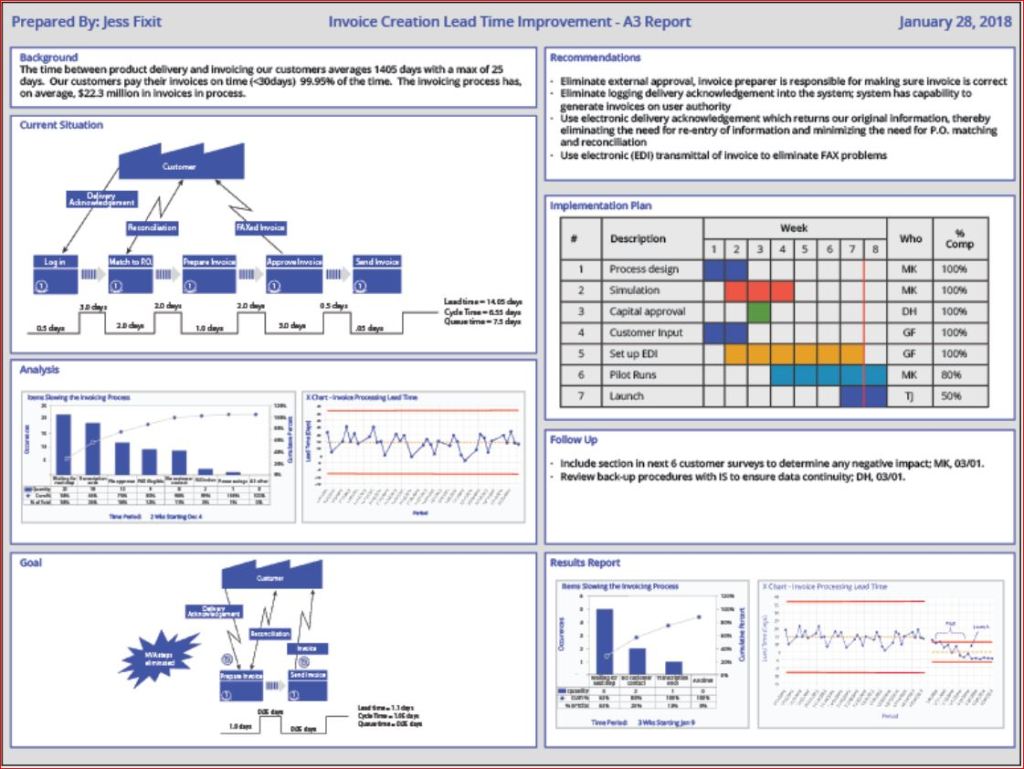
The A3 Report is a model developed and used by Toyota and currently used by many businesses around the world. The A3 Report is named for a paper size-A3 (29.7 x 42.0cm, 11.69 x 16.53 inches). The entire current state and PDCA aspects of the project are captured visually for easy communication and reference. When CIP projects use an A3 methodology to track projects, it has been demonstrated that clear visual communication helps the team members and the overall organization be more aware of the team’s progress.
A minor improvement event, in my experience, is generally four weeks to six weeks. Still, when an issue needs to be addressed thoroughly, the organization must be willing to invest more time and resources. Almost every moment of improvement time spent may be wasted if the true root cause is not adequately addressed due to failure to properly invest resources. There are four distinct phases: 1) preparation and training; 2) process mapping and current state analysis; 3) process mapping and future state analysis; and 4) implementation and ownership. I will put up a basic template below and walk through the A3 report.
Example

- Clarify the Problem
- IS/IS Not Analysis-excellent first tool to use to define the scope of the problem.
- After the scope of the problem has been defined, define the problem relative to the organization or process. The focus should always be on an underlying process or systematic issue, not an individual failure. Systematic failures are frequent but can be corrected with teamwork. The problem statement should never include a suggestion for a solution.
- Breakdown the Problem
- Clearly define the problem in terms of the 5 Why’s and 2 W’s (Who?, What?, When?, Where?, Why? And How?, How much or often?
- Set goals for improvement towards the ideal state vs current state
- Team sets S.M.A.R.T. goals relevant to block 1 state, establishing the end improvement target
- Root Cause Analysis
- Team uses focus areas from block 2 to determine Root Cause(s) employing relevant RCA tools
- Common RCA tools
- Cause-Effect/Fishbone Diagram
- 5 Why Analysis
- Fault Tree Analysis
- Pareto Chart
- Clearly state the determined root cause(s) and display the output of the tools
- Develop Countermeasures
- The team should take the root cause/causes from Block 4 and assign specific countermeasures.
- Countermeasures should directly address the root cause and, in theory, should solve the problem identified in Block 1.
- The completed fifth block is populated with any tool that will outline the countermeasures.
- Implement Countermeasures
- The team tracks the countermeasures from Block 5 and ensures each one is accomplished.
- The completed sixth block should be populated with the tool used in Block 5 to outline the countermeasures and updated as each is accomplished.
- Monitor Results and Process
- Effectiveness Check of Countermeasures
- Before/After Analysis
- SPC Control Charts
- Use Data from block 1 to determine if countermeasures from block 5 are having the desired effect relative to the target.
- If countermeasures are not effective, go back to RCA-block 4 (PDCA) and reconvene.
- Use the tool from block 6 to track countermeasure as ineffective in Block 7
- Effectiveness Check of Countermeasures
- Standardize successful processes
- If countermeasures are effective-
- Standardize all successful processes and note successful countermeasures as Standardized as they are approved using the tool from block 6 in Block 7
- A separate block can be used for Standardized processes
- If countermeasures are effective-
Conclusion
A complete A3 report can use many different tools, depending upon the problem being examined, so don’t fall into the habit of always using the exact same format. Be certain all four phases are completed. Innovation comes from creativity, so leave behind SOPs that demand exact clones of past reports. You may be dealing with a problem no person in your organization has yet to encounter, so outside of the box is thinking should always be on the table (Not locked away in a closed mind)

Processing…
Success! You're on the list.
Whoops! There was an error and we couldn't process your subscription. Please reload the page and try again.


 Try Amazon Prime 30-Day Free Trial
Bibliography
Quality Management Journal, Volume 16, 2009 – Issue 4
Published Online: 21 Nov 2017
Quality Progress Volume 49, 2009 – Issue 1
Jan 2016
Six Common Weaknesses With Teams

REFLECTION: FOR STUDENTS: “If two men on the same job agree all the time, then one is useless. If they disagree all the time, both are useless.” —Darryl F. Zanuck
FOR ACADEMICS: “If you have built castles in the air, your work need not be lost; that is where they should be. Now put the foundations under them.” —Henry David Thoreau
FOR PROFESSIONALS/PRACTITIONERS: “Don’t be afraid to give up the good to go for the great.” —John D. Rockefeller
Foundation
Teams and teamwork are much more a part of Quality and general business culture than a generation ago. The lone wolf “I’ve got this” type is almost extinct- but they are still highly useful due to being productive and often individually creative. I will not make this discussion about individual vs. team performance. The focus of this post will be to highlight some of the common failings in team dynamics (internal and external forces included), to help raise awareness. Too often, a team has become a “magic wand” used to fix a problem, and the team leader may have to drag a lot of that weight if the team does not properly understand how each moving part has to function for full success. When each part of the team has full accountability, the members are much more invested, and the team overall improved.
Team Weaknesses
- Team goals can become misaligned with the goals of the organization
- When teams and/or their decisions are not accepted and supported by management, the efforts of the team are wasted
- Time is needed to build and maintain high-performance teams
- Decision making is typically slower using a team because of the time it takes to make a decision by consensus
- Teams can also create negative synergy, where time is wasted simply because of the effort it takes to work with other people, or because teams get distracted with off-task activities, including social interactions
- Teams can be impacted by “group think”, in which the desire for harmony or conformity in the team results in lack of diversity of thought, shutting down of alternative points of view, and dysfunctional decision making
(WestFall, 2016)
Discussion
The first weakness (more often known as lack of strategic alignment) can make the team feel like they are accomplishing something, only to be informed mid-project or post-project that the overarching organization has a different goal. I would not count that so much as a team weakness, but more as a common communication failure between Management and teams.
Lack of Top Management support is a severe moral dampener to any team. Even if a team is successful despite lack of support, Implementation may not occur when Management offers no support.
Time is money, and because it takes time to build a good team, it drains financial resources. The time required to be dedicated to maintaining teams often pulls focus from day-to-day activities. Tasks required by Teams for special operations should never overwhelm the day to day work of standard operations.
Team Decision Making- Most teams have hit the wall of being unable to reach a consensus. This natural weakness can be overcome by using techniques like multivoting or Nominal Group Technique especially with a facilitator.
Negative Synergy is a common issue and can be well addressed with team self-discipline, a diligent and attentive facilitator, or a combination of both as required.
“Group Think” is one of the worst enemies of effective teams. No member of the team should fear to put forth a dissenting opinion. When a team is open to being questioned, the team is actively practicing critical thinking. One of the ways teams can avoid the phenomenon of “Group Think” is by creating ground rules that require objective data to be presented to make a decision. I would caution, though, that statistics can be twisted to look pleasing to your personal view, so each team member should be just as responsible for confirming the stats on their own after a presentation.
Conclusion
Potential team weaknesses should be considered when evaluating Project Risks. The ability to mitigate those risks as a team will help the team be a more cohesive unit.
Processing…
Success! You're on the list.
Whoops! There was an error and we couldn't process your subscription. Please reload the page and try again.
Try Amazon Prime 30-Day Free Trial
Bibliography
WestFall, L. (2016). The Certified Software Quality Engineer Handbook 2nd Edition. Milwaukee, WI: ASQ Quality Press.
Leadership From the Viewpoint of Motivation

REFLECTION: FOR STUDENTS: “Nothing in the world can take the place of perseverance. Talent will not; nothing is more common than unsuccessful people with talent. Genius will not; unrewarded genius is almost legendary. Education will not; the world is full of educated derelicts. Perseverance and determination alone are omnipotent.”
Calvin Coolidge
FOR ACADEMICS: “Motivation is a fire from within. If someone else tries to light that fire under you, chances are it will burn very briefly.”
Stephen R. Covey
FOR PROFESSIONALS/PRACTITIONERS: “People rarely succeed unless they have fun in what they are doing.”
Dale Carnegie
Foundation
The best leaders understand two key things: The nature of Motivation and the nature and consequences of Self-Betrayal. First, a Leader must realize how one person cannot motivate another. The feeling of motivation is brought about by creating an environment where the person feels comfortable and motivated. There are two categories of motivation: Extrinsic and Intrinsic.
Extrinsic Motivation– The satisfaction gained from material or psychological needs applied by others in the organization through incentive or reward.
Intrinsic Motivation- The qualities of work or of relationships, events, or situations that satisfy basic psychological needs (achievement, power, affiliation, autonomy, responsibility, creativity, and self-actualization) in a self-rewarding process. (Russell T. Westcott, 2014)
The concept of Self-Betrayal is a bit more abstract but inherent in all human beings. An act of Self-Betrayal is an act contrary to what you feel you should do for another person (or even for the organization). (The Arbinger Institute, 2010)
What a Leader Needs to Know about Self-Betrayal
The best way to categorize the behaviors and attitudes that lead to acts of Self-Betrayal is In the Box and Out of the Box. Out of the Box means you see yourself and others more or less as we are- as People or Entities. When you are In the Box, you see yourself and others in a systematically distorted way-Others are mere objects. Existing in the Box can create barriers to effectiveness in change, coping, communicating, implementing new skills, or even changing your behavior.
What Follows Acts of Self Betrayal

- You begin to see the world in a way that justifies the self-betrayal
- Self-Justification (without objective evidence) leads to a distorted view of reality
- You enter The Box
- Over time, individual boxes become characteristics of you, and you carry them with you
- By being in the Box, you provoke others to enter their Box
Getting out of your Box as a leader is essential to leading others out of their Boxes. Being in the Box is not a passive act. Being in the Box is actively resisting what your humanity is calling you to do. While in the Box, you are assigning blame to people rather than trying to help improve. The blame game serves no useful purpose.
Once you stop resisting your natural tendencies and honor your original commitment to do what is best for the person beside you or what is best for the company, most of the barriers will evaporate. (The Arbinger Institute, 2010)
Conclusion
A good leader cannot push “followers”. The very term follower precludes the concept of pushing, so others must be motivated from within, either Intrinsically (just from the internal reward) or driven from within by the feeling that comes with an external incentive or reward (Extrinsically). Culture and the interconnectedness of the organization are essential. Remove yourself from the Box and connect with all others on a human level, or you as a leader will become just an object to your followers, and your followers will begin to seem distorted objects as well. If the entire culture is built upon a distorted reality, nobody will see the organization as a living entity worthy of serving. The organization will morph into an object to be used and abused. Lead your employees and your organization out of the Box, and lead towards a culture that is value-added for all stakeholders.
Processing…
Success! You're on the list.
Whoops! There was an error and we couldn't process your subscription. Please reload the page and try again.
Try Amazon Prime 30-Day Free Trial
Bibliography
Russell T. Westcott. (2014). The Certified Manager of Quality/Organizational Excellence. Milwaukee, WI: ASQ Quality Press.
The Arbinger Institute. (2010). Leadership and Self-Deception. San Francisco: Berrett-Koehler Publishers, Inc.
10 Common Team Process Problems-And Their Solutions

REFLECTION: FOR STUDENTS: “Alone we can do so little; together we can do so much.” – Helen Keller
FOR ACADEMICS: “If I have seen further, it is by standing on the shoulders of giants.” – Isaac Newton
FOR PROFESSIONALS/PRACTITIONERS: “No one can whistle a symphony. It takes a whole orchestra to play it.” – H.E. Luccock
Foundation
Issues with successful Teambuilding and team project execution about in the Quality and Management world, so I will give a quick overview of 10 of the most common team process problems, as well as potential solutions to those problems. Good Team Dynamics has a direct correlation with Team productivity and success, so take problem-solving down to the team dynamics level if you want your teams to thrive.
The ten problems I will discuss-
- Floundering (Failure to Launch or Close)
- Team members using title or authority to influence the team process flow (stealing empowerment)
- Team members who talk too much (making other viewpoints hard to voice)
- Team members who don’t participate enough (leaving potentially valuable input in their heads)
- Blind acceptance of opinions as facts, or team members making opinions sound like facts.
- Rushing to a solution or conclusion before a team has conducted the full problem-solving process
- Damaging Team Dynamics by attempting to explain other members’ motives
- Team members ignoring or ridiculing one another’s values statements made
- Team constantly drifts off the main Agenda and spends too much time on unfocused conversation.
- Conflict involving personal matters
Solving any of these issues begins with three critical items. First, the team must have a clear written Charter to avoid any disagreement about the actual problem, scope, objectives, and timeline currently on the table. Second, the first meeting should establish meeting ground rules for conduct that can be updated as a group as required. Third, it is best to include a member of the team who’s role is Facilitator. The Facilitator’s purpose is not to become involved in the content of the meeting, but to act to help the team avoid slow progress (or roadblocks) during difficult situations and act as a catalyst for the team while evaluating the team objectives and progress. (Russell T. Westcott, 2014)
The Solutions-
The solutions below are not the only solutions or necessarily the best, just examples of overcoming a problem.
- Floundering- The Team Leader or Facilitator should use the Charter to redirect the team to the recorded objectives.
- Team Member(s) Using Organizational Influence to Influence Team Process- Talk to the member or members attempting to use their power to influence the team off-line. Be certain to clarify the impact of their organizational role and how it may affect the team. Highlight the need for consensus, not agreement out of fear team members might feel repercussions for offering dissenting opinions. Ask for cooperation and patience.
- Team Members talk too much- Practice a form of Gatekeeping that structures the meetings in a way that requires the entire team to write down their opinion on a topic of discussion. Then the individual views are discussed as a group one opinion at a time. The “talking stick” technique works well also.
- Team Member reluctant to participate- Once again, a form of Gatekeeping is a good solution when members will not speak up. Lack of input from shyness or intimidation can deprive the team of useful information, so asking each member of the team to speak on the issue will encourage conversation. Direct assignments with the need to report on actions and progress with help foster involvement as well.
- Blind acceptance of opinions as facts- The best solution to this is to respectfully challenge a view being presented as fact by asking for the supporting data.
- Rushing- Remind your Team of the cost (in terms of dollars and lost time) of jumping to the wrong conclusions. Dollars and time carry a lot of weight in decision making.
- Attempting to explain other members’ motives- Avoid pointing fingers; turn to the person who has had their motives explained, and ask, “would you please clarify that for the team” so that motives do not become accusations. If it becomes a consistent issue, take the offender off-line and ask them to stick to the problems and objective evidence. Adding a Conduct rule is possible if there are team dynamics issues (especially when your pool of team members is small).
- Ignoring or ridiculing one another’s values or statements made- Listening and understanding should be emphasized to the team. The Team Lead and Facilitator should support the Discounted person or persons. Remind everyone that some ideas seem crazy until they succeed.
- Digression/tangents- Remind members of the agenda and time estimates. This problem is where a Facilitator is most helpful. Always move the meeting back on track, reminding the Team of the current mission, objectives, and norms established.
- Conflict-Take real conflict off-line and Reinforce ground rules of conduct.
(Russell T. Westcott, 2014)
Conclusion
These problems within a Team should never be solved with generic solutions, and each team will have such a unique perspective that only your team can answer these problems for you. Still, it must be your team together that solves your internal team process problems, or the main issue your team is facing will continue to go unsolved or ineffectively solved.
Processing…
Success! You're on the list.
Whoops! There was an error and we couldn't process your subscription. Please reload the page and try again.
Try Amazon Prime 30-Day Free Trial
Bibliography
Russell T. Westcott. (2014). The Certified Manager of Quality/Organizational Excellence. Milwaukee, WI: ASQ Quality Press.
How Do You Define Good Leadership?

REFLECTION: FOR STUDENTS:
“The challenge of leadership is to be strong, but not rude; be kind, but not weak; be bold, but not bully; be thoughtful, but not lazy; be humble, but not timid; be proud, but not arrogant; have humor, but without folly.”
— Jim Rohn, entrepreneur and motivational speaker
FOR ACADEMICS:
“A leader is best when people barely know he exists…when his work is done, his aim fulfilled, they will all say: We did it ourselves.”
— Lao-Tzu, an ancient philosopher and founder of Taoism
FOR PROFESSIONALS/PRACTITIONERS:
“A true leader has the confidence to stand alone, the courage to make tough decisions, and the compassion to listen to the needs of others.”
— General Douglas MacArthur
Foundation
I have seen Leadership defined in many ways. One who inspires or influences is a Leader to some. Others see a person who sets an example worthy of following as a Leader. In the Quality world, Leadership is paramount. The Leadership of Quality teams, Major Projects, and Cross-Functional teams are usual functions as a QE or QM. Effective Leadership is a highly complex responsibility. Unfortunately, there is no simple recipe for executing Leadership. Because those you lead will be at varying levels of maturity, this can throw some leaders off. Those leaders who do not consider the maturity factor may not provide the needed guidance. A good leadership model is Hersey and Blanchard’s situational leadership model(Russell T. Westcott, 2014). This model focuses on three factors:
- 1.Task Behavior
- Level of work-related detail & guidance a leader must provide
- Extent to which direct action must be taken with the follower
- Relationship Behavior
- Extent of communication required with the follower
- Amount of coaching/support given a Follower
- Employee Maturity or Readiness
- The ability of follower to assume risk
- Willingness of follower to assume the task
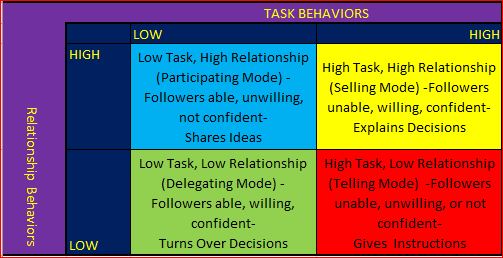
- High Task, Low Relationship (Telling Mode). In this mode of Leadership, specific instructions are given, and close supervision of performance occurs. Using the Telling Mode would be typical for a new employee until the job skill has been developed
- High Task, High Relationship (Selling Mode) This style of Leadership involves an explanation of decisions and an opportunity to clarify and ask questions as the Follower needs. At this stage, the employee has learned the necessary skills but is learning the why of the how.
- High Relationship, Low Task (Participation Mode) The Leader acts as a coach, and ideas are shared and encouragement provided. The Participation stage is the stage just before the training wheels come off.
- Low Relationship, Low Task (Delegating Mode) The leader now shifts responsibility for decisions and implementation to the employee. Successful Delegation is the culmination of a Leader doing their job effectively
(Russell T. Westcott, 2014)
Conclusion
This Model is not a guarantee of success. It is merely a tool to help guide a leader down the right path, enabling a leader to use the most appropriate mode of leadership. One style cannot fit all situations, so a Leader must adapt to the employee and the situation. An outstanding leader will re-evaluate which mode to employe each time a leader interacts one on one. The truly engaged and aware leader needs to be aware of other potential factors, such as health issues, personal/life issues, conflicts caused by co-workers damaging team dynamics, and working conditions. Leading is teaching, but refusing to move beyond the Telling Mode is only “Managing,” not Leading, and will drive good talent away over time.
Processing…
Success! You're on the list.
Whoops! There was an error and we couldn't process your subscription. Please reload the page and try again.
Try Amazon Prime 30-Day Free Trial
Bibliography
Russell T. Westcott. (2014). The Certified Manager of Quality/Organizational Excellence. Milwaukee, WI: ASQ Quality Press.
Lean Supply Chain Vs. Cutting Costs to the Bottom Line

REFLECTION: FOR STUDENTS: Study Deming’s philosophy, and and observe how critical Culture is to how Toyota dominates long term.
FOR ACADEMICS: Teach how interconnected organizations are more resilient than silo shaped organizations
FOR PROFESSIONALS/PRACTITIONERS: If Top Management is using Lean incorrectly for short term financial savings, demonstrate using COPQ how the Hidden Factory is damaging the company under the disguise of “Lean”. If they still will not react strategically, search for other employment, as the more valuable you are to the company, the more easily you are converted into short term savings. Cutting the experienced and hiring those fresh out of school with little to no experience is a quick way to claim “savings”. Replacing the years of lost experience by training the new employees and paying for all their errors is a massive expense.
The Goal of Lean Management
Some (especially top management and supply chain) misinterpret lean as the ability to do more with less by eliminating waste and decreasing costs.
This idea of Lean often leads to two critical issues-
1. Companies cutting labor that is no longer “needed” to “reduce waste” so they can “do more with less.” It is a fancy way of telling the rest of the company employees to work harder to take up the slack for all the people I just fired and is very damaging to buy-in. Companies lose tribal knowledge that the company was unable to capture, and new learning costs are incurred when the costliest employees are cut to save money (and it is a frequent occurrence when Lean is used for cost-cutting).
2. Supply Chain chooses suppliers based upon financials, and OTD, not supplier quality. Lots of promises and preliminary approvals that drag on and on. You get what you pay for. Low cost frequently equates to low quality. If a competitor knows their product is better, they will raise the price because others will want to buy it. Cheap suppliers look good for the first quarter, but when the hidden costs of rework and recalls hit, somebody has to be held accountable.
Was it Quality’s fault? Supply Chain’s fault? No. It was the Administration was accountable for allowing the hidden factory back into the culture. Supply Chain especially should be able to understand when the QM tells the board that we need to invest in better suppliers. The goal of Lean management is to maximize customer value while minimizing waste. Allowing rework into the factory through the supplier is a total waste of resources, and it can cost a lot of money, time, and, frequently, loss of reputation in the eyes of potential customers. Investment in your company brings long term gains, not slashing people and resources.

It is also essential to set up an APQP/PPAP process that matches the needs of all the stakeholders. Two main factors to consider are the expected Volume of orders for the product or service and the Variety of products / and services. With products of high levels of variety (such as frequent custom orders) with relatively low product volume, Agile Project-type planning control is most effective. Low variability (not much change customer to customer), but substantial orders, would bring about a need for lean planning.
Conclusion
Lean is not a tool to be used like a Machete to “cut the fat” quarter to quarter. Eventually, while you are hacking at the perceived “weeds and vines” you will cut your company’s foot off and some of your foundation will be lost. Add value and eliminate waste carefully by categorizing value and waste as a team.
Processing…
Success! You're on the list.
Whoops! There was an error and we couldn't process your subscription. Please reload the page and try again.
Try Amazon Prime 30-Day Free Trial

How Software Quality Engineering and Design Quality Are Similar

REFLECTION: FOR STUDENTS: If your education looks as if it may lead to a point where you have interactions that involve a QMS, be sure to pursue at least a basic understanding of software, as that understanding will be gold in all future industry employment.
FOR ACADEMICS: AI and ML are coming, but it will be a while before any doctors or engineers are actively replaced, but it would be wise to teach your students how to think for yourself, not just rely upon the computer. Teach students to be the person who writes the program or qualifies the program, not the person who is told by the computer what to do.
FOR PROFESSIONALS/PRACTITIONERS: Learn all you can about the software world if you have not yet. If you are purely a Software Quality Engineer, get as much exposure to other quality systems to help open your mind up to different problem-solving pathways. Always be a lifelong learner.
Definition of Quality
There is no single definition of quality that has ever or likely ever will be agreed upon even in a single company, much less an entire industry or across industries, but the ISO/IEC/IEEE Systems and Software Engineering-Vocabulary (ISO/IEC/IEEE, 2010)
provides an excellent layout of every aspect of defining quality.
- The degree to which a system, component, or process meets specified requirements
- The ability of a product, service, system, component, or process to meet customer or user needs
- The totality of characteristics of an entity that bears on its ability to satisfy stated and implied needs
- Conformity to user expectations, conformity to user requirements, customer satisfaction, reliability, and level of defects present
- The degree to which a set of inherent characteristics fulfills requirements
Each organization must decide what quality is, however, only a world-class organization will always be using the feedback from all stakeholders to evolve the organization’s definition of quality so that stakeholders are satisfied at every level.
Changes Are Coming
I have written a couple of posts about how Quality 4.0 and Industry 4.0 are here. However, based upon the fact that the Quality industry is in many areas still building the foundations of a Quality culture that will support Quality 4.0, there are likely to be many quality professionals who fall into one of three major groups.
Some may be in a state of denial or unawareness of the exponential growth level of the emerging technology and believe things will stay the same as they have for all these years. The next group is made up of those who are fully aware of the changes that are coming. The members of this group and are getting ready for the inevitable change. The last, and most likely smallest group (though I have no formal data, shame on me), would be those who know what is coming but actively do not want the change to occur.
The reason I believe that would be the smallest group would be the fact that the vast majority of quality professionals are problem solvers, change agents, and not comfortable with things just staying as they are. The old “If it isn’t broke, don’t fix it” axiom is the antithesis of the Quality mindset.
Software Quality Engineering
In the past few years, I have witnessed the medical device industry evolve rapidly. A few years ago, I saw DHFs (Design History File), DMRs (Device Master Record), and DHRs (Device History Record), all kept on paper in files in a locked room and carefully controlled. Quickly the entire paradigm shifted to Cloud storage of these documents with ultra-tight security, in addition to management of routing of document approvals moving from physical signatures to electronic signatures. I also witnessed software become officially regulated as medical devices (SaMD).
Software Quality Engineering is- The study and systematic application of scientific technology, economic, social, and practical knowledge, and empirically proven methods, to the analysis and continuous improvement of all stages of the software life cycle to maximize the quality of software processes and practices, and the products they produce. Generally, increasing the quality of software means reducing the number of defects in the software and in the processes used to develop/maintain that software (WestFall, 2016). Software development usually uses an Agile project management approach. Agile project management seems to draw heavily from the Lean philosophy, which focuses on creating better customer value while minimizing waste. Both philosophies emphasize fast deliverables. The emphasis of Lean is on reducing waste and unnecessary steps; however, Agile emphasizes breaking large tasks into small ones and delivering in short sprints. Both Lean and Agile use some sort of an action loop. In Lean, this is the build-measure-learn cycle, while Agile’s scrum methodology uses an iterative sprint approach (L. Allison Jones-Farmer, 2016).

The iterative steps used as part of the Agile Scrum methodology help prevent excessive costs. When a defect is not caught early in the development of software, the defect can impact many more aspects of the software. The later in the life cycle the defect is detected, the more effort (and therefore expense) it will take to isolate and correct defects. A single defect in the requirement phase may have a “butterfly effect” and cause exponential levels of cost as the defect goes undetected.
At the end of each iteration, the goal would be to have a working example demonstratable for stakeholder review and feedback so that any issues with correctness or quality can be addressed in the next iteration (WestFall, 2016).
Traditional Design Quality
Design Quality from the manufacturing perspective aligns closer to Crosby’s viewpoint of the need for a well-defined specification against which to measure quality. One of the things about the fast-changing Quality world is that software is less about the reproducibility to spec and more about innovation. As the manufacturing world has found itself thrown into a massive acceleration in the last few decades, traditional design perspectives have been re-evaluated. Engineering tools like TRIZ have been employed to help spur innovation in design and problem-solving. Design For Six Sigma (DFSS) shifted product design away from just doing it right the first time toward robustly employing QFD to obtain the voice of the customer. The best DFSS process for a new design (in my opinion) would be the IDOV method- Identity (obtain VOC & CTQs), Design, Optimize, Validate. At the Validate stage, a prototype is tested and validated, with risks thoroughly analyzed (and as required, sent back to an earlier stage if validation is not accepted) (Kubiak, 2017). I have seen more and more manufacturing operations learning to use agile methods for design, frequently combining Agile with Lean, Six Sigma, or Lean Six Sigma depending upon the culture and knowledge base. It is clear that as software, apps, and AI become integral parts of product and production, the pace at which innovation must occur to meet customer requirements will continue to grow, perhaps eventually leading to a permanent fusion of Agile, Lean, and Six Sigma.
Conclusion
There are many other methodologies out there, like the waterfall mythology, which has lost a bit of popularity over the past few years to Agile methods, as well as CMMI, which I have heard conflicting reports on how compatible CMMI is with Agile. I would appreciate input from those in the software industry who can tell me firsthand how well CMMI and Agile work together. Software DevOps is effectively designing a product for stakeholders from ideation to operational release and monitoring/maintenance. Designing a physical item to sell on the market based upon the VOC using a QFD may be slower and use a more thorough investigation of the requirements and desired outputs (since you are addressing something tangible rather than an idea for a program). An idea that can provide value (software) is much harder to define in a neat specification box. Still, just like a DOE, you keep adjusting your settings and continue trying until you determine what factors are critical. Then you optimize the settings for your critical factors to obtain the best outcome based upon cost, functionality, and VOC. If you are worried about the coming changes, do not be worried, embrace the change, and be part of the change. Yes, in 20 years, we will all be behind a computer console writing code (if AI has not replaced al the Quality Engineers), but as long as you are looking forward, you will be moving in the right direction.
Processing…
Success! You're on the list.
Whoops! There was an error and we couldn't process your subscription. Please reload the page and try again.
Try Amazon Prime 30-Day Free Trial
Bibliography
ISO/IEC/IEEE. (2010). ISO/IEC/IEEE 24765 Systems and Software Engineering. Geneva, Switzerland: ISO New York, NY.
Kubiak, T. a. (2017). The Certified Six Sigma Black Belt Handbook Third Edition. Milwaukee: ASQ Quality Press.
L. Allison Jones-Farmer, P. T. (2016, 10). asqstatdiv.org. Retrieved from ASQ: http://asq.org/statistics/2016/10/agile-teams-a-look-at-agile-project-management-methods.pdf
WestFall, L. (2016). The Certified Software Quality Engineer Handbook 2nd Edition. Milwaukee, WI: ASQ Quality Press.

How to Communicate the Cost of Quality (COQ) In a Way Top Management Understands

REFLECTION: FOR STUDENTS: Use your business and management classes to prepare you for Improvement Project management. Nothing happens in a business unless it is profitable.
FOR ACADEMICS: If you are teaching Project Management be sure to teach more than “Top Management must support your team”. It will help greatly if team members understand why top management must buy into a project, as the economic model cannot be explained at the beginning of every project.
FOR PROFESSIONALS/PRACTITIONERS: If your organization finds itself in a silo mentality between production, quality and management, always use cost as the negotiating method. Hard dollars are not subjective or debatable.
What is the Cost of Quality?
I use the term Cost of Quality because the common term Cost of Poor Quality (COPQ) seems to fail to capture all the efforts in the quality metric that should be communicated to Top Management.
For many years there was a lack of understanding between the production and quality department. Quality usually knew when a process was wasteful, but production was not particularly concerned with operational excellence. The prime metric from a production standpoint was, “How many widgets did we produce this shift?” and “Did it meet our Quota?”. The scrap costs and rework costs were hidden deeply in the metrics, not because the data did not exist, but because the data were not being actively tracked. Top Management frequently was blind to the full cost of all the quality efforts and failures that were occurring during production (or even design quality costs).
This lack of communication led to the infamous “Hidden Factory” effect that drove the first wave of modern Quality Guru’s to try to bring Quality to the forefront of Business consideration. Taguchi, Crosby, Juran, Deming, Ishikawa, and Ohno all had similar views on waste, though they did not all have the same philosophies.
The end result was: After many years, the Culture of Quality and Change Management has become more the norm (though there is still far to go in many areas). Most Top Management has a language with which they can talk to the Quality and Production departments and can share, and that language is Dollars. Top management had always wanted a bottom-line impact report. It was not genuinely concerned with what Quality had to say until Quality started talking about lost dollars that impacted the bottom line.
Since the actual cost of producing a product to spec is approximately 15% for manufacturing firms, varying from as low as 5% to as high as 35% based upon product complexity of total costs, it presents a clear opportunity to cut the bottom line for reducing these overall costs (Joseph M. Juran, 2010) (Bill Wortman, 2013).
There are three primary categories of Quality Costs categorization: Prevention, Appraisal, and Failure. Once your organization has a firm classification of these costs, choosing to document the quality costs will provide project managers with a way to measure and prioritize Quality Improvement projects. Peter Drucker is credited with the obvious truth – “If it cannot be measured, it cannot be improved”.
Though some individual items such as Audits overlap, this is a useful high-level guide to categorizing your Quality Costs. (Failure has been divided into Internal and External Failures)
- Prevention Costs of Quality- Total cost of all activities used to prevent poor quality and defects from becoming part of the final product or service.
- Quality Training and Education
- Quality Planning
- Supplier qualification and supplier quality planning
- Process Capability evaluation (including QMS audits)
- Quality Improvement activities
- Process Definition and Improvement
- Appraisal Costs of Quality- The total cost of analyzing the process, products, and services
- Document Checking
- Analysis, review and testing tools, databases, software tools
- Qualification of the supplier’s products
- Process, product, and service Audits
- V & V activities
- Inspection at all levels
- Test equipment maintenance
- Failure Costs of Quality- The costs which result from products and services not conforming to requirements or customer/user needs.
- Internal Costs of Failure
- Occur prior to delivery
- Scrap
- Design changes
- Repair
- Rework
- Reinspection
- Failure documentation and review
- Occur prior to delivery
- External Costs of Failure
- Occur after delivery or during the furnishing of the service
- Customer complaint Investigations
- Pricing errors
- Returns and Scrap
- Warranty Expenses
- Liability claims
- Restocking
- Engineering Change Notices
- Occur after delivery or during the furnishing of the service
- Internal Costs of Failure
- (Wortman, 2013) (WestFall, 2016)
Conclusion
Top management support is required for an improvement project.
Any quality dept. will want to improve a process, but for a business, a business case must be presented to top management so they will help remove the roadblocks and provide resources. The quality department must be able to present the estimated ROI (Return on Investment) using the Cost Benefits Analysis to show that there is a viable business case for supporting the improvement project to gain support for the project. Even though improving a process may be the smart thing to do, sometimes it is not the financially viable thing to do at the time. Keep those projects on a back burner and monitor them, though. At some point, some changes may make the improvement much more viable.
Processing…
Success! You're on the list.
Whoops! There was an error and we couldn't process your subscription. Please reload the page and try again.
Try Amazon Prime 30-Day Free Trial
Bibliography
Bill Wortman. (2013). The Certified Biomedical Auditor Primer. West Terre Haute, IN: Quality Council of Indiana.
Drucker, P. (1954). The Practice of Management. New York City: Harper & Row.
Joseph M. Juran, J. A. (2010). Juran’s Quality Handbook (Sixth Ed). New York: McGraw-Hill.
WestFall, L. (2016). The Certified Software Quality Engineer Handbook 2nd Edition. Milwaukee, WI: ASQ Quality Press.

Team Development

REFLECTION: FOR STUDENTS: When institutions mandate team learning, were you provided proper project management skills or were you thrown to the wolves to meet administrative requirements? Teamwork should be a holistic process, and if team learning is mandated, then the proper training should be provided for all teams to begin learning on an equal footing (a few freshmen out of high school may be in the same class as project managers). You are a customer! Do not fear the administration and use your Voice as a Customer to demand proper teaching methods be provided.
FOR ACADEMICS: I have heard horror stories of the teams that never move beyond forming during mandated team projects, and then the entire team is penalized no matter how hard they worked or how much they learned. In real life, an obstinate member of a team would be kicked out by the sponsor or team leader (or even fired from their job) before that member was allowed to impede the goal of the team (after some serious coaching). Still, academia frequently masks that aspect of the private sector from students. Have you integrated yourself as the “sponsor” to allow the team leader or team to appeal directly to you to resolve unresolvable conflict issues, perhaps making it part of the grade (based upon the team’s presentation and documentation of any issues)?
FOR PROFESSIONALS/PRACTITIONERS: Do you consider likely team dynamics and personal histories that might be significant distractions or believe the project will blind the team members to personal biases? If you believe the goal will overcome personal biases, I would say it can, but usually only under duress. Adding extra factors for a team to overcome is like adding additional factors to a DOE. It takes many more runs before they are sure they have it right, so if you know of conflict factors that can be eliminated, the time to do it would be when the team is chosen, though sometimes there are not enough resources for that level of filtering.
Common Types of Teams
Teams can manifest as required to achieve the goal, and it is essential to remember that the configuration of the team will be a significant contributor to how the team functions, so be sure your team is configured with the end goal in mind.
- Process Improvement Teams
- Self-Managed Teams
- Temporary/ad hoc teams
- Work groups
- Cellular teams
- Special Project Teams
- Virtual Teams
- Combinations of two or more of the above types
Team Selection
Management should select the team leader to ensure 100% management support for the team’s goal.
Team members may be selected by management or the leader. Still, I would suggest empowering a leader to choose the best team when a team leader chooses his/her team, using the five primary areas of competence known as the KESAA factors to analyze the fit of the candidates for the needs of the project.

Formal Education, Degrees, Educational Certifications, Professional Certifications, Self-Study achievements
Experience
Time spent actively applying knowledge and skills in pertinent types of organizations and industries and in jobs/positions held
Skills
Skill certifications documented training and demonstrated proficiency in the use of relevant tools and equipment
Aptitude
Natural talent, capability, capacity, innate qualities, deftness, adaptability to change, high learning speed
Attitude
Manner of showing one’s feelings or thoughts; one’s disposition, opinion, mood, ideas, beliefs, demeanor, state of feeling, reaction, bias, inclination, emotion, temperament, mental state, frame of mind, ease in accepting and adopting new or changed plans and practices.
-After utilizing a KESAA analysis, be sure you have every need for the project covered with a well-chosen cross-functional team.
Stages of Team Development

Stage 1: Forming
- Proud to be selected
- Anxious
- New team experience
- Forming team structure
Individuals come together and merge, each with their perceptions and priorities. This forming helps the team to move closer to a single entity and to define and clarify the team’s purpose, goals, and roles and rules for acceptable behavior within the group (norms).
Stage 2: Storming
- Individualistic thinking
- Struggle between external loyalties and devotion to team goals
- Fluctuating attitudes
- Confrontations
- The team’s task is understood
At this point is when individual goals conflict with team needs and objectives, and initial decisions are based upon old paradigms or perhaps just old emotions and conflicts.
Current information relative to the task and goal must be pooled and utilized. Then the team has to begin to shape itself by overcoming major conflicts and focusing on the proper behavior required to succeed for the next step in the team’s evolution.
Stage 3: Norming
- Team coalesces
- Cooperation
- Individuals willing to dialogue
- Conflicts reduced
- Focus is on team objective
At this stage, the individual members of the team overcome their personal biases and previous conflicts, coalescing into a team. The team finds itself shifting the full focus of the team’s efforts to meeting team-related challenges rather than individual concerns. Discussion of differences for the sake of the team becomes the Norm, resulting in a standard of team cooperation and constructive dialogue.
True Diversity of Thought emerges. Note: from my experience- (if the Norm fails to be achieved, the Performing level usually will not be optimal, though it can still succeed).
Stage 4: Performing
- Team has matured
- Smooth, cohesive unit
- Focus on process and goal
- Feelings of satisfaction
- Achieving goals
The team members have a good understanding of one another’s strengths and weaknesses, and how they contribute to the end goal and are effectively able to resolve conflict and appreciate the team as an individual entity. This is the stage where the real strides toward achievement are occurring.
Adjourning
Tuckman’s original model ended at the performing stage, but a final stage is now standard- the Adjourning stage. The reason this phase is so critical is that though the stages represent the normal logical procession of team development, team dynamics can influence the actual flow of progress. Forcing teams to regress to earlier stages to overcome previous assumptions about one another, decisions made upon inaccurate information, or to welcome new team members is a real possibility. Some teams never progress beyond a certain point of development due to outside forces combined with inner team dynamics.
Limited project duration and poor group dynamics can be significant issues.
Anytime a team successfully achieves a Performing level, and the team’s mission has been successful, the post-project stage of Adjourning should be performed to capture lessons learned, what was accomplished, complete, and assign documentation, celebrate, and formally disband.
(Russell T. Westcott, 2014)(CSSBB Primer, 2014)(Kubiak, 2017)
Conclusion
Team Dynamics are often overlooked during critical projects for the data, but important decisions are often made based upon how the individual members of the team work together as a team. Never underestimate the importance of a leader and facilitator with excellent soft management skills.
Processing…
Success! You're on the list.
Whoops! There was an error and we couldn't process your subscription. Please reload the page and try again.
Try Amazon Prime 30-Day Free Trial
Bibliography
CSSBB Primer. (2014). West Terre Haute , Indiana: Quality Council of Indiana.
Kubiak, T. a. (2017). The Certified Six Sigma Black Belt Handbook Third Edition. Milwaukee: ASQ Quality Press.
Russell T. Westcott. (2014). The Certified Manager of Quality/Organizational Excellence. Milwaukee, WI: ASQ Quality Press.

8D vs PDCA & DMAIC
REFLECTION: FOR STUDENTS: Are you using critical thinking or using a paint by the numbers method to solve problems?
FOR ACADEMICS: Are you providing your students with the tools needed to distinguish between “guidelines” and mandates?
FOR PROFESSIONALS/PRACTITIONERS: Is your organization allowing you find the true root cause of an issue or forcing you to fill out a form within a certain time frame? Try to convince top management to allow teams to properly explore root causes, and if management continues to violate standards by ignoring the concept of due diligence in favor of meeting the closure rate when more time should have been allotted- file a CAPA. It is your duty as a Quality Professional.
What is 8D?
I have been performing CAPAs for many years. I have employed many methods: The Tried and True PDCA, the DMAIC approach, and even utilized the A3 path when the visual display of ongoing CAPAs was critical to communication (or mandated by policy). The Eight Discipline (8D) Approach has been the path that was least used by me, as it was (to me) least flexible. For those who are proponents, it works fine, but it seems more about CAPA closure by the numbers and documentation than it is about teaching your team to be independent critical problem solvers. While 8D will work well in any industry if implemented correctly, 8D is more template-based than PDCA. Have no doubt, DMAIC is quickly becoming template-like via software applications. A basic template is a useful guide, but the less controlled the problem solving, the more likely the team is to arrive at an innovative solution.
For those who are unsure what the Eight Disciplines are, let me elaborate on the Eight Disciplines:
Originally Ford developed the 8D method in the late 80s, and it spread to most of the automotive industry.
The Ds in this method are not acronyms (as many seem to struggle with), but rather a set of “Disciplines” to follow for problem-solving. These Disciplines were widely transferred to “forms” that became “8D Forms”, used for root cause analysis and correction of problems with unknown causes.
8D Method
- D0- Plan for solving the problem and determine resources needed
- Before 8D analysis begins, proper planning will always translate to a better start.
- SME Input
- Collect data on issues
- Identify any need for an Emergency Response Action (ERA)
- D1-Use a Team
- Choose the right type of team, right team members
- Teams require proper preparation.
- Set the ground rules
- 8D must always have two key members: a Leader and a Champion / Sponsor
- D2- Define and Describe the problem
- Specify by identifying in quantifiable terms the who, what, where, when, why, how, and how many (5W2H)
- 5 Why or Repeated Why (Inductive tool)
- Problem Statement
- Affinity Diagram (Deductive tool)
- Fishbone/Ishikawa Diagram (Deductive tool)
- Is / Is Not (Inductive tool)
- Problem Description
- D3- Develop interim containment plan
- Implement Interim Containment Actions (ICA)
- Verification of effectiveness of the ICA is always recommended to prevent any escapes to customers
- D4- Determine, identify, and verify root causes and escape points
- Comparative Analysis listing differences and changes between “Is” and “Is Not”
- Development of Root Cause Theories based on remaining items
- 5 Whys
- C&E Diagrams
- Determine Escape Point, which is the closest point in the process where the root cause could have been found but was not
- Review Process Flow Diagram for location of the root cause
- D5- Choose Permanent Corrective Action (PCA)
- Establish the Acceptance Criteria which include Mandatory Requirements and Wants
- Perform a Risk Assessment / Failure Mode and Effects Analysis (FMEA) on the PCA choices
- Based on risk assessment, make a balanced choice for PCA
- Select control-point improvement for the Escape Point
- Verify the PCA will resolve root cause of problem and any escape points issues
- D6- Implement and Validate PCAs for problem/nonconformity
- Define and Implement the best PCAs
- Validate PCAs using objective measurement
- D7- Prevent recurrence
- Review Similar Products and Processes for problem prevention
- Develop / Update Procedures and Work Instructions for Systems Prevention
- Capture Standard Work / Practice and reuse
- Assure FMEA updates have been completed
- Assure Control Plans have been updated
- Preserve and share the knowledge, preventing problems on similar products, processes, locations or families
- D8- Congratulate your team
- Archive the 8D Documents for future reference
- Document Lessons Learned on how to make problem-solving better
- Before and After Comparison of issue
- Celebrate Successful Completion
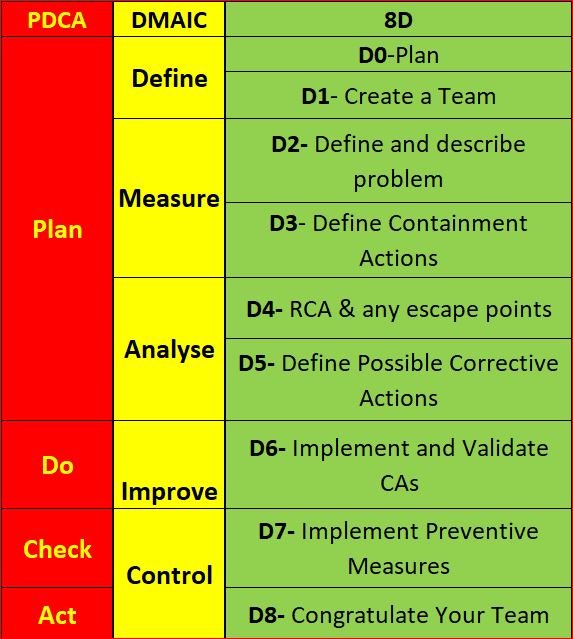
If you have interacted with a Six Sigma Team or a PDCA Root cause team, you know how the DMAIC and PDCA compares. For illustration, I have them side by side. 8D is much more broken down than the others. Using PDCA, the assumption is that a team acting in a PDCA cycle will have top management support and that those involved have the proper knowledge and training required to gather and analyze data to determine a solution. Also assumed is that the resources are available to improve the issue, Measurement of the results is always part of the cycle, and reacting to the final results of the Check on the improvement will yield either a successful CA/Improvement or begin a repeat of the cycle (basically the scientific method).
Most consider DMAIC the same as PDCA, just more focused on clarifying the PDCA cycle in order to reduce iterations by shifting the focus away from potential multiple cycles to achieving the most effective improvement the first time (though failure is still built into the process). The 8D method is once again pretty much the same process, as you can see.
When DMAIC and 8D are highly templated, a lot of the focus moves from solving the root cause toward closing the CAPA within the mandated time.
Making problem-solving quick and easy makes it easy to pencil whip. I would suggest you avoid the potential pencil whip methods. Have a group that must think for themselves and writes the report using only basic guidelines (not templates).
Conclusion
While I have clearly indicated I am not a fan of 8D and not happy with the way DMAIC is being pushed into templates, I do not mean to say that any single technique is better than another. Essentially, they are all the same method, re-focused. 8D is very conducive to utilizing documentation of project results and assigning work breakdown structure accountabilities (WBS) DMAIC is better for cross-functional communication and can be used for similar documentation. The Shewhart PDCA cycle is more of a high-level outline that allows the improvement project to be adjusted as required by SMEs. Choose the method that suits your needs, and as long as a cross-functional team performs proper due diligence with full top management support, the outcome will usually be similar regardless of the method chosen.
Processing…
Success! You're on the list.
Whoops! There was an error and we couldn't process your subscription. Please reload the page and try again.
Try Amazon Prime 30-Day Free Trial
Bibliography
ASQ. (nd). ASQ Quality Resources. Retrieved from WHAT ARE THE EIGHT DISCIPLINES (8D): WHAT ARE THE EIGHT DISCIPLINES (8D)?
Pruitt, W. F. (2019, May). A Disciplined Approach. Retrieved from ASQ Quality Progress: http://asq.org/quality-progress/2019/05/back-to-basics/a-disciplined-approach.html
Quality One. (nd). Quality One. Retrieved from Eight Disciplines of Problem Solving (8D): https://quality-one.com/8d/
 Quality Concepts Matter