What is an A-3 Report?

REFLECTION: FOR STUDENTS: “Having no problems is the biggest problem of all.”- Taiichi Ohno
FOR ACADEMICS: “Data is of course important in manufacturing, but I place the greatest emphasis on facts.”- Taiichi Ohno
FOR PROFESSIONALS/PRACTITIONERS: “Make your workplace into showcase that can be understood by everyone at a glance.”- Taiichi Ohno
Foundation
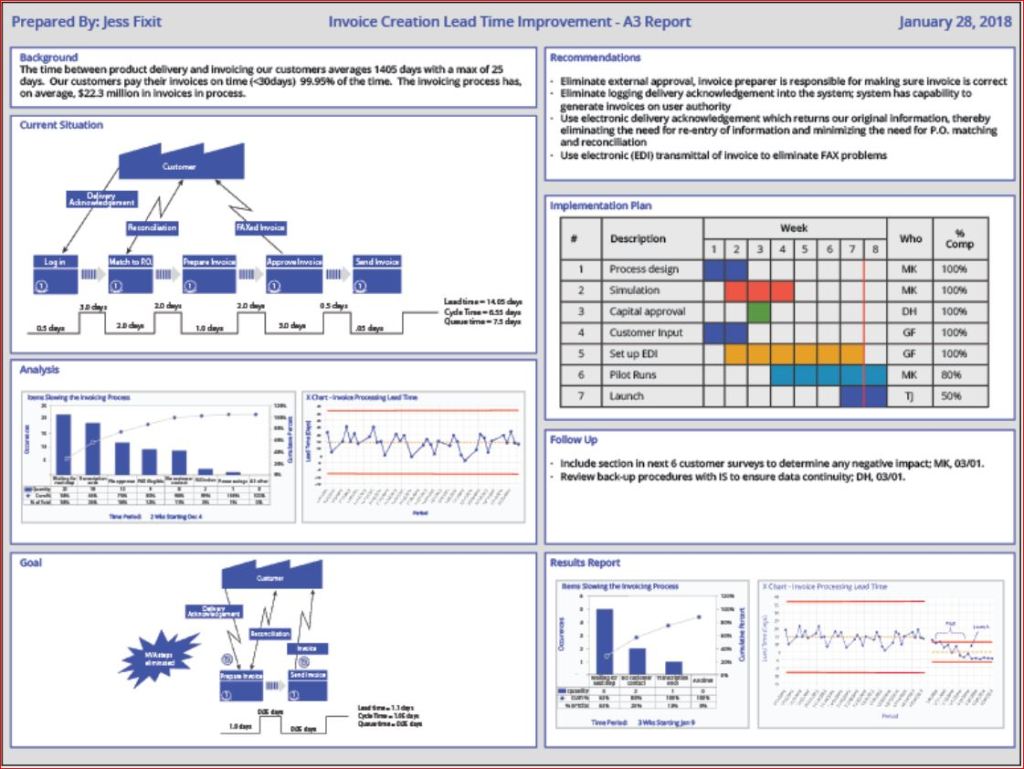
The A3 Report is a model developed and used by Toyota and currently used by many businesses around the world. The A3 Report is named for a paper size-A3 (29.7 x 42.0cm, 11.69 x 16.53 inches). The entire current state and PDCA aspects of the project are captured visually for easy communication and reference. When CIP projects use an A3 methodology to track projects, it has been demonstrated that clear visual communication helps the team members and the overall organization be more aware of the team’s progress.
A minor improvement event, in my experience, is generally four weeks to six weeks. Still, when an issue needs to be addressed thoroughly, the organization must be willing to invest more time and resources. Almost every moment of improvement time spent may be wasted if the true root cause is not adequately addressed due to failure to properly invest resources. There are four distinct phases: 1) preparation and training; 2) process mapping and current state analysis; 3) process mapping and future state analysis; and 4) implementation and ownership. I will put up a basic template below and walk through the A3 report.
Example

- Clarify the Problem
- IS/IS Not Analysis-excellent first tool to use to define the scope of the problem.
- After the scope of the problem has been defined, define the problem relative to the organization or process. The focus should always be on an underlying process or systematic issue, not an individual failure. Systematic failures are frequent but can be corrected with teamwork. The problem statement should never include a suggestion for a solution.
- Breakdown the Problem
- Clearly define the problem in terms of the 5 Why’s and 2 W’s (Who?, What?, When?, Where?, Why? And How?, How much or often?
- Set goals for improvement towards the ideal state vs current state
- Team sets S.M.A.R.T. goals relevant to block 1 state, establishing the end improvement target
- Root Cause Analysis
- Team uses focus areas from block 2 to determine Root Cause(s) employing relevant RCA tools
- Common RCA tools
- Cause-Effect/Fishbone Diagram
- 5 Why Analysis
- Fault Tree Analysis
- Pareto Chart
- Clearly state the determined root cause(s) and display the output of the tools
- Develop Countermeasures
- The team should take the root cause/causes from Block 4 and assign specific countermeasures.
- Countermeasures should directly address the root cause and, in theory, should solve the problem identified in Block 1.
- The completed fifth block is populated with any tool that will outline the countermeasures.
- Implement Countermeasures
- The team tracks the countermeasures from Block 5 and ensures each one is accomplished.
- The completed sixth block should be populated with the tool used in Block 5 to outline the countermeasures and updated as each is accomplished.
- Monitor Results and Process
- Effectiveness Check of Countermeasures
- Before/After Analysis
- SPC Control Charts
- Use Data from block 1 to determine if countermeasures from block 5 are having the desired effect relative to the target.
- If countermeasures are not effective, go back to RCA-block 4 (PDCA) and reconvene.
- Use the tool from block 6 to track countermeasure as ineffective in Block 7
- Effectiveness Check of Countermeasures
- Standardize successful processes
- If countermeasures are effective-
- Standardize all successful processes and note successful countermeasures as Standardized as they are approved using the tool from block 6 in Block 7
- A separate block can be used for Standardized processes
- If countermeasures are effective-
Conclusion
A complete A3 report can use many different tools, depending upon the problem being examined, so don’t fall into the habit of always using the exact same format. Be certain all four phases are completed. Innovation comes from creativity, so leave behind SOPs that demand exact clones of past reports. You may be dealing with a problem no person in your organization has yet to encounter, so outside of the box is thinking should always be on the table (Not locked away in a closed mind)

Processing…
Success! You're on the list.
Whoops! There was an error and we couldn't process your subscription. Please reload the page and try again.


 Try Amazon Prime 30-Day Free Trial
Bibliography
Quality Management Journal, Volume 16, 2009 – Issue 4
Published Online: 21 Nov 2017
Quality Progress Volume 49, 2009 – Issue 1
Jan 2016

Not Just S.M.A.R.T. But S.M.A.R.T.E.R!

REFLECTION: FOR STUDENTS: What is the best way to set your individual goals for maximum impact (for yourself, and for those around you) in an environment where you are juggling multiple classes, work, and maybe even a family?
FOR ACADEMICS: Are you setting goals for students using S.M.A.R.T. or S.M.A.R.T.E.R techniques in order to help your students better understand what is required of them for assignments?
FOR PROFESSIONALS/PRACTITIONERS: Consider the E.(Evaluate for Effectiveness) and R.(Reviewed) that are so often essential to proper and effective closure of a project or corrective action. Are they actually being practiced or are the last two aspects sometimes just absorbed into the project without positive determination and follow through action?
S.M.A.R.T. Goals!
I have seen the S.M.A.R.T. goal format used in goal setting for Annual Personnel Review goals, project goals, lean / six sigma project goals, and even in day to day goals for “to do” items. The S.M.A.R.T. acronym was first used by George Doran in 1981 to outline project management and personal development (Doran, 1981). The Original Five were oriented toward corporate and departmental goals (Management by Objectives).
- Specific: the specific targeted area for improvement
- Measurable: quantify an indication of improvement progress
- Assignable: indicate the responsible individual or team
- Realistic: state realistic results using available resources
- Time-related: specify when the results can be achieved
(CSSBB Primer, 2014)
The Specific and Measurable has not been altered much other than when used in different contexts, but over time the A.R.T. has developed some other possible meanings. I will provide a list of the original terms, along with a list of other common terms used. The remaining discussion afterward will focus on the S.M.A.R.T. goals that have been most relevant in my experience, though as you will see, there is room for discussion, based upon industry, role, urgency and many other factors.
| Letter | ORIGINAL TERM | OTHER TERMS |
| S | Specific | Significant, sustainable, simple |
| M | Measurable | Meaningful, manageable, motivational |
| A | Assignable | Achievable, attainable, ambitious, acceptable, aggressive, actionable |
| R | Realistic | Relevant, resourced, results-based, reasonable, results-oriented |
| T | Time-related | Time-bound, time-framed, time-based, time-specific, time-sensitive, time-limited, time-boxed |
As you can see, S.M.A.R.T. seems a bit flexible, but then, smart people should have flexible thinking. I have found Paul Meyer’s description of S.M.A.R.T. characteristics (Meyer, 2003) (CSSBB Primer, 2014) to be the most functional for goal setting relative to projects and corrective actions. The terms in the table above in bold and underlined are the ones we will address:
Specific: A specific goal should answer these five questions (usually)-
- Who is involved?
- What will be accomplished
- Why does this need to be done?
- Where is the location?
- Which requirements and constraints are apparent?
Measurable: Concrete criteria for measuring progress toward accomplishment of the goal-
- How Much?
- How Many?
- How will the team know when the goal has been achieved?
- How will the indicators be quantified?
Achievable: A goal that is both realistic and attainable. A goal is considered achievable if you can answer the question:
- How can my team accomplish this goal
Relevant: Only goals that truly matter should be set. These goals need to be supported by resources and management. Any relevant goal should answer these questions:
- Is the goal worthwhile?
- Is this the right time?
- Are we (or I) the right team/person?
- Does the goal align with our other needs (align with strategic objectives)?
- Is it applicable in the current environment?
Time-Bound: Goals should be grounded with a time element such as a target date in order to establish a sense of urgency and answer questions like:
- What can be done immediately?
- What can be done in a designated time?
- When can it be totally accomplished?
Why Do We Need S.M.A.R.T.E.R. Goals?
What is a SMART goal? It is a tool used to implement Management By Objectives, also known as MBO (Drucker, 1954). Management by Objectives presents many positives toward the achievement of specific goals (tactical goals) while attempting to achieve the larger strategic goals, but MBO does present some opportunities for misuse. What should be a system of two-way communication encouraging growth between manager and team with a shared vision toward achieving final results often devolves into a situation where management is placing consistent demands on the employee(s) to achieve said results but disregards the concept of using MBO for commitment, round table contribution, and management development. Even well-meaning managers may misuse MBO because they lack the interpersonal skills required to avoid their appraisal sessions from turning into pure criticism sessions. Many managers have an unfortunate tendency to see MBO as a catch-all system that, once installed, can handle all management problems. This has led to forcing issues onto the MBO system that it is not fully equipped to handle and that partially or completely mute whatever good effects might be seen in the actual issues with which pure MBO is actually more suited to deal (Drucker, 1954).
S.M.A.R.T.E.R. goes about the same way as S.M.A.R.T., but the added E. and R. are the critical elements that help mitigate traditional MBO. S.M.A.R.T.E.R. adds:
E for Evaluate for effectiveness: measure and determination that the goal has (or has not) been meet (or the corrective action has/has not been determined effective based upon sample data and criteria)
-Without a true understanding of the effectiveness, the evaluation of an end goal or corrective action should never be considered complete
R is a little wishy-washy. I have seen R for (Recognized/Rewarded or Revisited), which works very well, though the celebration of achievement has been built into a general project structure, and revisiting a project/CA would occur based upon the evaluation of effectiveness if it is determined ineffective. The other concept of R., which I prefer more, is Reviewed, which is more a final risk analysis/assessment of the project or corrective action confirming nothing added or changed has had an adverse impact on your overall system. This Review should always be cross-functional (Susan Napier-Sewell, 2019).
| S.pecific | Objectives should specify what they need to achieve |
| M.easurable | You should be able to measure whether you are meeting the objectives or not |
| A.chievable | A goal that is both realistic and attainable |
| R.elevant | Only goals that truly matter should be set. These goals need to be supported by resources and management and aligned with Strategic Goals |
| T.ime Bound | When do you want to achieve the set objectives? |
| E.ffective | Measure and determine if the goal has (or has not) been meet (or if CA has/has not been effective) |
| R.eviewed | The documentation that a cross functional team has reviewed the output and effectiveness of the project/CA and confirmed that the benefits to the system and customer outweigh any negative impact the process |
Conclusion
Having the Effectiveness in mind as part of the goal can very much impact how you and your team go about achieving your goal. When your team takes on the responsibility for mitigating and avoiding potentially negative effects that can come about from changes to systems, then some of the communication barriers fall, and teams seek out those they must talk to in order to avoid future problems with what they are implementing. Silo mentality causes a lot of project rework, but good communication and solid forethought solve many problems before they have a chance to manifest. When Management hands over the Effectiveness and Review power to teams, Management becomes more part of the team trying to get everything right rather than a potential evil overlord (though that can still happen when things are not managed correctly).
Processing…
Success! You're on the list.
Whoops! There was an error and we couldn't process your subscription. Please reload the page and try again.

 Try Amazon Prime 30-Day Free Trial
Bibliography
CSSBB Primer. (2014). West Terre Haute , Indiana: Quality Council of Indiana.
Doran, G. (1981). There’s a S.M.A.R.T. Way to Write Management Goals and Objectives. Management Review, 35-36.
Drucker, P. (1954). The Practice of Management. New York City: Harper & Row.
Meyer, P. J. (2003). Attitude is Everything. Meyer Resource Group.
Susan Napier-Sewell. (2019, November 15). What Is SMARTER & What Does It Have To Do With My Investigation? Retrieved from TapRoot Root Cause Analysis: https://www.taproot.com/what-is-smarter-what-does-it-have-to-do-with-my-investigation/
 Quality Concepts Matter